AI-Native Crypto Operations: Practical Workflows for Real Teams
Most teams treat AI like a faster typewriter. They paste a prompt into ChatGPT, get a draft back, edit for twenty minutes, and call it “using AI.” That’s not an AI crypto workflow. That’s outsourcing one sentence at a time.
Real AI-native crypto operations look different. They don’t start with “write a tweet thread about our tokenomics.” They start with a decision someone needs to make: Should we adjust our liquidity strategy this week? The AI doesn’t just generate text — it gathers signals, cross-references sources, flags what changed, and hands the operator a brief they can act on without second-guessing the evidence.
I’ve spent the last two years building these workflows — not as demos, not as “AI theater,” but as operating infrastructure that survives contact with deadlines, team handoffs, and the relentless pace of crypto markets. Some of them run daily. Some of them failed the first three times and taught me more than the ones that worked.
This article is a field manual. No hype. No “AI will replace your team” predictions. Just a practical framework for building AI web3 automation that a real ops team can deploy, maintain, and trust.
Key Takeaways
- Most crypto teams are still at Level 1 of AI maturity — using single prompts instead of chained workflows that connect research to execution
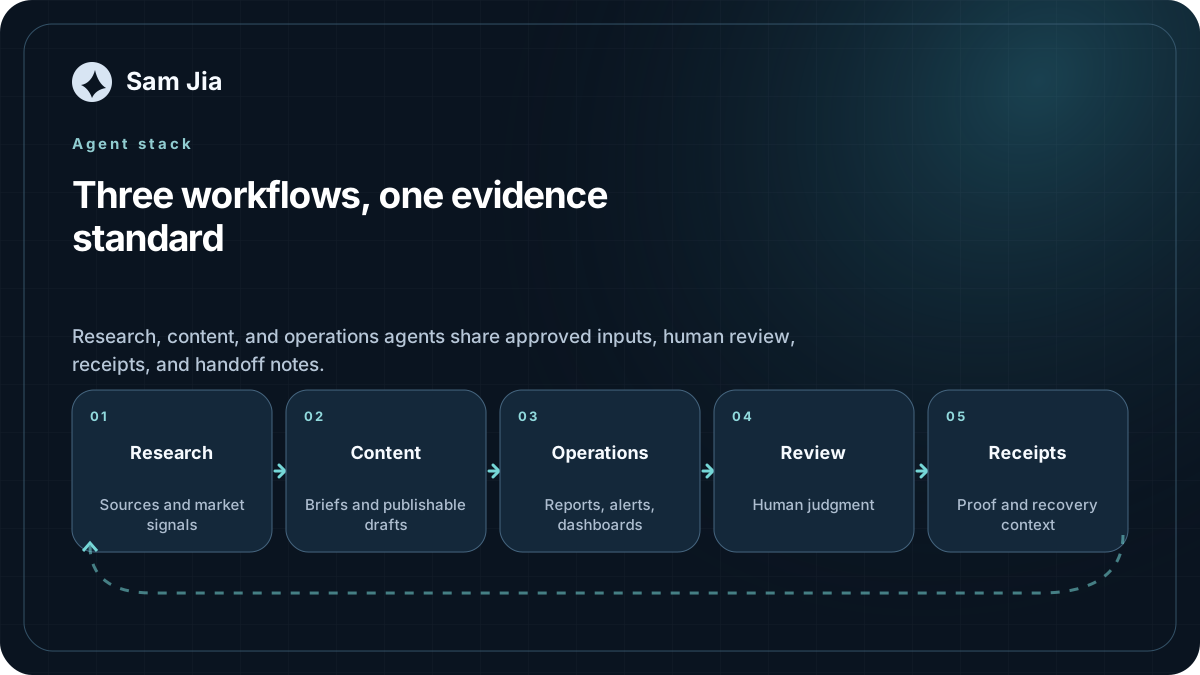
- Three AI workflows produce immediate ROI for crypto teams: a research agent for market monitoring, a content agent for publishing pipelines, and an operations agent for reporting and alerts
- AI automation that “survives the handoff” requires explicit input contracts, visible failure states, and documentation written for the next operator — not just the builder
- The operator’s moat shifts from execution speed to judgment quality: knowing what to automate, what to keep human, and when the AI’s confidence is fake
- AI won’t replace crypto operators — but an operator with a working AI system will replace one who’s still doing everything manually
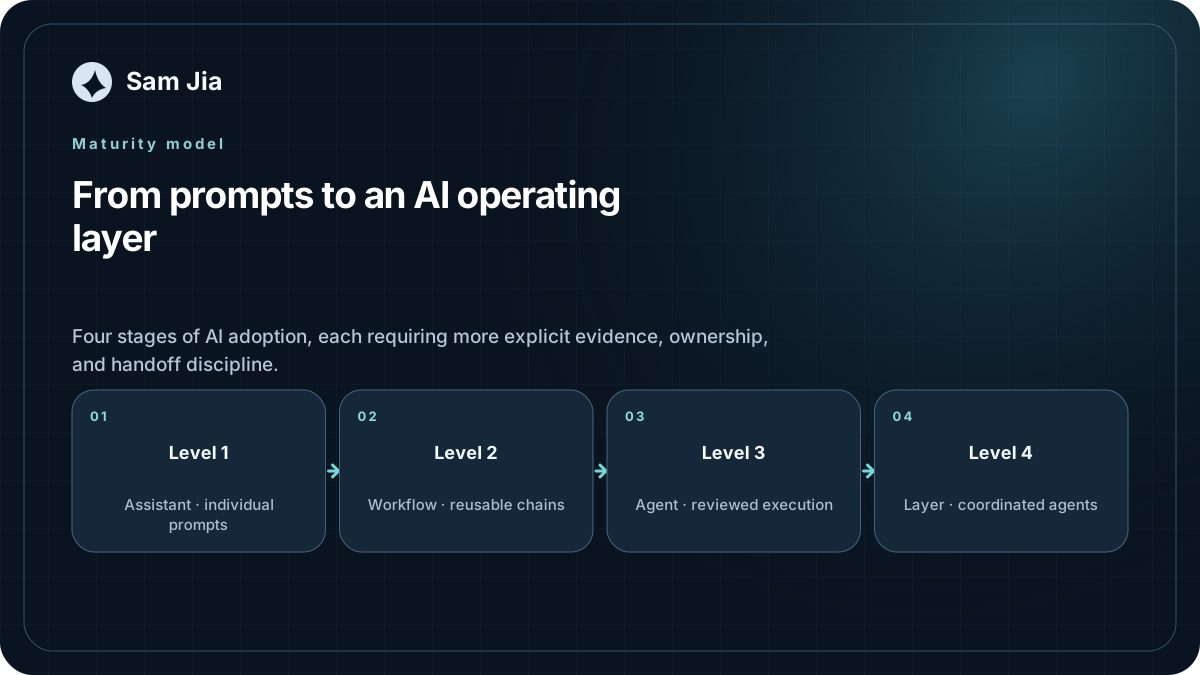
The AI Operations Maturity Model for Crypto Teams
After building AI crypto workflows for myself and teams across DeFi and infrastructure projects, I’ve seen the same progression play out enough times to map it. Most teams believe they’re at Level 3. Most are actually at Level 1 — and the gap between perception and reality is where the real operational drag lives.
Level 1 — AI as Assistant: Individual Prompts
This is where every team starts. Someone on the marketing team uses ChatGPT to polish a tweet. A researcher pastes a whitepaper into Claude and asks for a summary. A BD lead uses an AI note-taker during partner calls.
What it looks like: Isolated prompts. Zero shared infrastructure. The quality of output depends entirely on who’s typing and what mood the model is in that day.
The real problem at Level 1: Nothing compounds. If Jenny writes a brilliant competitor analysis prompt, nobody else on the team knows it exists. When she leaves, the prompt leaves with her. The team is “using AI” but building zero organizational leverage.
I saw this firsthand at a DeFi project I was supporting in early 2024. The team of seven had probably fifty ChatGPT tabs open across different machines. Every researcher had their own method. Every content person had their own approach to fact-checking. When the market moved fast — a competitor launched a fork, a protocol got exploited — there was no system. Just seven people typing faster.
That’s not AI adoption. That’s AI chaos.
Level 2 — AI as Workflow: Chained Prompts and Templates
At Level 2, the team starts treating prompts as assets. They build templates. They chain multiple steps. Instead of “summarize this article,” they build a sequence:
- Extract key claims from the article
- Cross-reference each claim against two other sources
- Flag contradictions or unsupported assertions
- Output a structured brief with confidence scores
What changes: The output becomes predictable. Another team member can run the same workflow and get a comparable result. The prompts live in a shared document or a Claude Project. The team starts to develop taste — they know what a good output looks like and they know when the AI is hallucinating.
I moved my own AI crypto workflow stack to Level 2 around mid-2024. The trigger was a research cycle for a protocol launch. I needed to monitor three competitor launches, two regulatory developments, and daily sentiment shifts across Discord and X — all while maintaining a content pipeline. Doing it manually took about 14 hours per week. Chaining prompts into a workflow cut that to about 5 hours. The quality improved too, because the prompt chain forced consistency.
Level 3 — AI as Agent: Autonomous Execution with Human Review
Level 3 is where the workflow starts running without a human pressing “go.” The agent triggers on events — a price movement, a competitor announcement, a scheduled time — executes the full chain, and presents results for human review.
The critical distinction at Level 3: The human is not operating the workflow. The human is reviewing the output and making decisions.
A Level 3 research agent for a crypto team might:
- Wake up at 8:00 UTC, pull the last 24 hours of on-chain data from Dune and Nansen
- Cross-reference with X sentiment from an API endpoint
- Compare with the previous 7-day baseline
- Generate a morning brief that highlights anomalies
- Post it to a team channel with source links
The operator reads the brief over coffee, trusts the sources are traceable, and makes one decision: do we act on any of this, or do we keep moving?
The hard part at Level 3: Not the technology. It’s building the operator’s confidence to let go. Most people can’t resist checking the raw data “just to be sure.” The first month of running a Level 3 agent, you’ll probably still open Dune manually. That’s normal. Trust takes reps.
Level 4 — AI as Operating Layer: Multi-Agent Systems
Few crypto teams are here yet. I’m not fully here myself, and I’d be suspicious of anyone who claims they are.
Level 4 means multiple agents running in parallel, each owning a distinct function, with handoff protocols between them. The research agent feeds the content agent. The content agent feeds the publishing pipeline. The operations agent monitors them all for failures and sends alerts when something breaks.
The Level 4 reality check: If you can’t maintain a single Level 3 agent for 60 days without it silently failing, you’re not ready for multi-agent systems. Build one workflow that survives the handoff. Then build the next one. Multi-agent is a scaling problem. Most teams haven’t solved the unit economics of a single agent yet.
a16z Crypto’s overview of AI and crypto crossovers is a useful wider map of where agents, ownership, identity, and open networks intersect. For an operations team, however, the maturity test remains narrower: can one bounded workflow run with visible evidence and accountable review?
Three AI Workflows Every Crypto Team Should Deploy
Theory is cheap. Here are three AI web3 automation workflows I’ve built and battle-tested. Each one produces real operational leverage — not just “more content,” but better decisions, faster.
Research Agent: Market Monitoring, Competitor Analysis, Due Diligence
Crypto research is a signal-to-noise problem that gets worse the longer you ignore it. The information is distributed across X, Discord, Telegram, GitHub, on-chain explorers, and governance forums. Manually aggregating it is a full-time job. Most teams settle for “checking CT a few times a day” and calling it monitoring.
What a research agent does:
Every morning at a scheduled time, it pulls from configured sources and generates a structured brief:
MARKET SIGNALS — 2026-08-11
━━━━━━━━━━━━━━━━━━━━━━━━

Changed since yesterday:
• [Protocol X] TVL dropped 12% → cross-checking shows 3 large withdrawals from a single wallet. Not a protocol exploit.
• [Competitor Y] announced a partnership with [Wallet Z]. First mention of this wallet in their ecosystem.
• [Keyword "re-staking"] sentiment shifted -8% on X, driven by a single influential thread questioning yields.

Unchanged / steady state:
• [Our protocol] TVL stable. No unusual withdrawal patterns.
• Governance proposals: 2 active, both routine parameter adjustments.

Items requiring a decision:
• The competitor partnership puts [Wallet Z] in play for integrations. Should BD reach out?
• The re-staking sentiment thread has 1,200+ RTs. Might affect upcoming narrative positioning.
The prompt architecture:
I use a chain of three prompts, not one:
-
Collection prompt: “You are pulling data from the following sources: [Dune query endpoints], [X search API for these 8 keywords], [DefiLlama TVL for these 5 protocols], [governance forums for these 3 DAOs]. Collect everything that changed in the last 24 hours. Do not summarize yet. Do not interpret. Just collect, timestamp, and label the source.”
-
Comparison prompt: “Compare today’s collection against yesterday’s baseline. Flag only items where the delta exceeds the threshold: TVL >5%, sentiment shift >10%, new partnership/rival announcement, exploitation or security event, significant governance activity. For each flagged item, state the specific number that changed and link the source.”
-
Briefing prompt: “Convert the flagged items into a morning brief with three sections: Changed / Steady / Decisions Required. Maximum 400 words. Every factual claim must cite a source from the collection step. If you cannot verify a claim, explicitly state ‘unverified — needs manual check.’”
Tools: Claude (Projects feature for prompt storage), Dune API, a basic X sentiment endpoint, and a scheduled trigger (cron job or n8n).
This workflow takes about 3-4 hours to set up properly and saves roughly 8-10 hours per week for a team that was doing this manually. More importantly, it catches things that manual monitoring misses — a competitor’s quiet GitHub commit, a sentiment shift that hasn’t hit CT virality yet, a wallet movement before it becomes a news story.
Content Agent: From Keyword to Publishable Draft
Most crypto content teams are trapped in a cycle: research → outline → draft → review → edit → publish → repeat. Every piece starts from zero. Every draft requires the same mental warm-up. The process is linear and fragile — if the lead writer is sick for a week, the pipeline stops.
What a content agent does:
It doesn’t replace the writer. It replaces the busywork around writing.
-
Research phase: Given a topic and target keywords, the agent searches, fetches, and structures source material — competitor articles, protocol docs, recent announcements, data points. Output: a research brief with source links.
-
Outline phase: From the research brief, the agent generates a content structure with H2/H3 headings, key arguments for each section, and data points to include. Output: a writing brief that a human reviews in 5 minutes.
-
Draft phase: Following the approved outline and brand voice guidelines, the agent produces a complete draft. Output: a publishable piece that requires human editing, not rewriting.
-
Publishing phase: The agent generates social variants (thread, LinkedIn post, Discord announcement), meta tags, and internal linking suggestions. Output: a publishing package.
The real numbers from my own pipeline:
Before this workflow, a 2,500-word SEO article took me roughly 8-10 hours: research (2-3h), outline (1h), draft (3-4h), editing and publishing prep (1-2h).
With the content agent pipeline, the same article takes about 3-4 hours: reviewing the research brief (20 min), approving the outline (15 min), editing the draft (1.5-2h), and reviewing publishing assets (30 min).
The article quality didn’t drop. In some ways it improved — the agent catches sources and data points I might have missed in manual research. What changed was the ratio: less time hunting and formatting, more time making editorial decisions.
A word on AI content quality: The agent produces usable drafts, not finished pieces. If you’re expecting publish-ready output with zero human touch, you’ll be disappointed. The value isn’t in replacing editorial judgment. It’s in eliminating the hours of structured busywork — source collection, outline structuring, SEO formatting, variant generation — that don’t require judgment at all.
Operations Agent: Reporting, Alerts, Dashboard Generation
Every crypto team has a weekly reporting ritual that someone dreads. Pull numbers from three dashboards. Screenshot charts. Write commentary. Format slides. Send to stakeholders. It’s 4-6 hours of work that produces a document most people skim for 90 seconds.
What an operations agent does:
-
Data collection: Pulls metrics from connected sources (Dune, Nansen, Google Analytics, social dashboards, community tools) at a scheduled cadence.
-
Anomaly detection: Compares current numbers against historical baselines and flags statistically significant deviations. “Total active wallets increased 34% week-over-week — this is 2.1 standard deviations above the 12-week mean.”
-
Commentary generation: Produces plain-language summaries for each flagged anomaly, with source context. “The increase correlates with the Quest campaign launched on August 6 and the subsequent spike in X mentions (see Appendix A).”
-
Output: A formatted report — could be a Notion page, a Slack message, a Google Doc, or a dashboard embed — with the numbers, the commentary, and the sources.
The real operational win isn’t time saved — though it saves 4-6 hours per week. The win is that stakeholders stop asking “can you pull the numbers for X?” because the report is always current, always sourced, and always in the same place. The operator stops being a data retriever and starts being a decision partner.
If these three workflows sound like what your team needs but the setup feels overwhelming, that’s exactly the gap I fill. Workflow Buildout → starts with an audit of your current ops, identifies the highest-ROI automation, and ships a working agent with full documentation. No AI theater. Just infrastructure your team can actually use.
Building AI Agents That Survive the Handoff
Here’s what nobody tells you about building AI agent crypto workflow systems: the hard part isn’t getting them to run. It’s getting them to keep running after you’re not watching them anymore.
I learned this the expensive way. Six months ago, I built a research agent for tracking DeFi protocol metrics. It ran beautifully for three weeks. Every morning, a clean brief in my Slack. I stopped checking the raw sources. Why would I? The output was consistent.
Week four, the agent started quietly failing. One of the Dune queries had been updated — the field name changed. The agent couldn’t parse the response, so it just omitted that section entirely. No error message. No flag. Just a morning brief that was missing a quarter of its data, and I didn’t notice for eleven days.
That failure taught me more about AI automation than every successful run combined. Here’s what I changed.
The Checklist: Inputs, Receipts, Handoff Notes
Every AI agent I build now ships with three things:
1. Input contract
A short document that states, in plain language:
- What data the workflow expects (sources, fields, formats)
- Required credentials and permissions
- Dependencies (APIs, local directories, browser sessions)
- What happens when a source is unavailable (skip? retry? alert?)
- Acceptable freshness windows (“this data can be up to 24h old,” “this data must be real-time”)
The input contract exists because most “agent failures” are actually input changes nobody documented. A Dune query gets renamed. An API rate limit changes. A Discord bot token expires. The agent didn’t break — its assumptions broke.
2. Execution receipt
A machine-readable record that proves what the agent did:
EXECUTION LOG — 2026-08-11T08:00:03Z
━━━━━━━━━━━━━━━━━━━━━━━━━━━━━
Workflow: morning-research-brief-v3
Trigger: scheduled (08:00 daily)

Sources attempted: 5
Sources succeeded: 4
Sources failed: 1 (Dune query #2 — field 'total_value_locked' not found in response)

Artifacts produced:
— morning-brief-2026-08-11.md (4.2 KB)
— source-raw-2026-08-11.json (28.1 KB)

Anomalies flagged: 2 (TVL drop 12%, sentiment shift -8%)
Time to completion: 47 seconds
The receipt exists because “the workflow ran” is not the same as “the outcome was produced.” Without a receipt, you’re guessing whether silence means success or failure.
3. Handoff note
A document written for the next operator — the person who inherits this workflow six months from now. It answers five questions:
- What outcome does this workflow own?
- What triggers it?
- What proves success?
- Where does it fail most often?
- What should the next operator never assume?
I write handoff notes in first-person present tense, as if I’m talking to someone standing next to me: “This workflow assumes the Dune API key is stored in environment variable DUNE_KEY. If you rotate keys, update line 12 of config before the next scheduled run, or the agent will fail silently on the Dune section.”
Why Most AI Automation Is Fragile (and How to Fix It)
Most AI automation breaks for predictable reasons:
| Failure mode | Why it happens | Fix |
|---|---|---|
| Silent degradation | Agent encounters unexpected data format, omits section, continues running | Require explicit receipts: “sources attempted: 5, sources succeeded: 5” |
| Assumption drift | API changes, query gets renamed, model behavior shifts | Input contract as living document; review monthly |
| Context collapse | Prompt too long or underspecified; agent misinterprets task | Break into short, single-purpose prompts with explicit checkpoints |
| Confidence inflation | Agent presents interpretation as fact; no uncertainty signal | Require “confidence: high/medium/low” on every analytical claim |
| Handoff failure | Original builder leaves; knowledge evaporates | Mandatory handoff note; test with someone who’s never seen the workflow |
The common thread: these failures aren’t technological. They’re documentation failures, assumption failures, and organizational memory failures. The AI part works fine. The operating system around it fails.
Documentation as the Operating System for AI
If you take one thing from this article, take this: documentation is not a nice-to-have for AI workflows. It IS the workflow.
A prompt is not a workflow. A prompt is a one-time instruction. A workflow is a prompt plus: input contract, execution receipt, handoff note, failure taxonomy, and a testing protocol.
When I audit a team’s existing AI automation, the first thing I check isn’t the prompt quality. It’s whether someone who didn’t build the workflow can explain:
- What it’s supposed to do
- How to know if it did it
- What to do when it doesn’t
If they can’t answer those three questions, the workflow is a personal script, not team infrastructure. It doesn’t matter how clever the prompt chain is.
From My Own Stack: What I Use and Why
People ask me what tools I use. The honest answer: fewer than you’d think, configured more carefully than most people bother to.
The Core Stack
Claude — primary reasoning engine. I use Claude Projects to organize prompts by function (research, content, ops) with shared context documents. The Projects feature matters because it means prompts inherit consistent context — brand voice, previous outputs, known constraints — without me repeating it every time. Anthropic’s prompt engineering overview starts from the same foundation: define success criteria and a way to evaluate them before tuning the prompt.
n8n — workflow orchestration. Connects the AI calls to triggers, data sources, and output destinations. Self-hosted, which matters when you’re handling API keys and internal data. I chose n8n over Zapier because I needed more control over error handling and the ability to inspect what happens between steps. Its AI workflow guidance emphasizes human checkpoints, rule-based validation, and audit trails rather than unreviewed autonomous output.
Dune API — on-chain data source. The agent pulls structured query results rather than scraping dashboards. The Dune API overview documents how saved queries can be executed and their results retrieved for automated analytics pipelines.
Markdown files + Git — persistent storage. Agent outputs are saved as Markdown files in a Git repo. This means every output is version-controlled, searchable, and reviewable. No black-box database. No “where did that report go?” The file system is the database.
A cron job running on a $6/month VPS — scheduler. Nothing fancy. It triggers the n8n workflows at configured times. If it goes down, the whole system goes quiet, and I get an alert. Simple failure modes are a feature, not a bug.
A Prompt Architecture That Actually Works
Here’s how I structure prompts for AI crypto workflows, with a concrete example from my content agent pipeline:
The design also follows Anthropic’s prompting best practices: state instructions clearly, supply relevant context, and use examples that match the output you actually want.
Layer 1 — System prompt (stored in Claude Project, rarely changes):
You are a research assistant for a crypto operations team. Your outputs
must follow these rules:

1. Every factual claim must cite a specific source with a link.
2. If you cannot verify a claim, state "unverified" and explain why.
3. Distinguish between observation (what happened) and inference
   (what it might mean).
4. When data is missing or contradictory, say so. Do not fill gaps
   with plausible guesses.
5. Output format: structured Markdown with clear section headers.
Layer 2 — Task prompt (the specific instruction for this run):
Task: Morning research brief for [Protocol Name]

Pull data from these sources:
1. Dune query #42 — daily active wallets, transaction volume
2. Dune query #87 — TVL by pool, 7-day change
3. X search: [5 competitor names], [3 industry keywords]
4. DefiLlama: [protocol slug] TVL and ranking

Comparison baseline: yesterday's values from
/research-baselines/2026-08-10.json

Flag anomalies exceeding:
- TVL change >5%
- Wallet count change >10%
- Significant competitor announcement
- Security or exploit event
Layer 3 — Output template (what the agent produces):
# [Protocol Name] Daily Brief — [Date]
## Changed (above threshold)
[Flagged items with: metric, delta, source link, confidence]
## Steady State
[Items within normal range — keep this section SHORT]
## Requires Decision
[Items that need human action, with recommended next step]
## Appendix: Sources
[Complete list of sources with timestamps]
This three-layer structure is the difference between a prompt that works once and a workflow that works every day. The system prompt defines the operating principles. The task prompt defines the current objective. The output template defines the standard format. Change any layer independently without breaking the others.
Real Results: Time Saved, Quality Improved, Decisions Accelerated
I track this because I don’t trust my own intuition about “feeling more productive.” Here’s the data from my own operations over the last 12 months:
| Workflow | Time before AI | Time with AI | Quality change |
|---|---|---|---|
| Weekly competitor monitoring | 8-10 hours/week | 2-3 hours/week | More consistent; catches items manual scan missed |
| Content pipeline (per article) | 8-10 hours | 3-4 hours | Comparable editorial quality; better source coverage |
| Weekly ops reporting | 4-6 hours/week | 1 hour/week | Higher stakeholder trust; fewer ad-hoc data requests |
| Partner due diligence (per deal) | 6-8 hours | 2-3 hours | More thorough background; consistent format |
Total operational time reclaimed: approximately 20-25 hours per week.
That’s not “AI is magic.” That’s AI handling the structured, repeatable parts of the work so I can spend time on what actually needs human judgment: deciding which competitor move matters, shaping the editorial angle, reading the room on a partner conversation, and knowing when the data is lying.
The Operator’s Role in an AI-Augmented Team
Let’s address the elephant in every crypto ops Slack: “Is AI going to replace my job?”
The short answer: no. But an operator with AI crypto workflows will replace an operator without them. That’s not a threat. It’s the same dynamic that played out with every productivity tool shift in history. Spreadsheets didn’t replace accountants — but accountants who could use spreadsheets replaced ones who couldn’t.
Judgment Becomes the Moat
When AI handles collection, formatting, and first-pass analysis, the operator’s value shifts entirely to judgment. The AI can tell you that sentiment dropped 8%. It can’t tell you whether that matters.
Judgment in crypto operations looks like this:
- The AI flags a competitor announcement. You decide: is this a real threat, or just noise dressed up as a partnership?
- The AI detects a TVL anomaly. You decide: does this require immediate investigation, or is this a whale doing whale things?
- The AI produces a content draft. You decide: is the angle right for this audience at this moment, or does it need a different frame?
- The AI suggests three partnership targets. You decide: which one actually has alignment, not just surface-level synergy?
These aren’t decisions the AI can make. They require context the AI doesn’t have: what happened in that Telegram group two months ago, which competitor’s team is actually competent, what the founder’s real priority is this quarter, what the community will react to emotionally versus rationally.
The operator’s new job description: receive structured, sourced information; apply contextual judgment; make one decision; move on. The AI does the pipeline. The operator does the steering.
What to Automate, What to Keep Human
This is the question I get most often, and the answer depends on one variable: does this task require context the AI doesn’t have?
Automate these:
- Data collection and formatting
- Cross-source comparison and anomaly detection
- First-draft content generation (articles, social posts, reports)
- Routine summarization (meeting notes, research papers, competitor updates)
- Scheduled reporting and dashboard generation
- Monitoring for defined events (price moves, competitor launches, sentiment shifts)
Keep these human:
- Strategic decisions based on AI-generated analysis
- Relationship-building (partners, community, investors)
- Crisis communication (exploit response, community blowup)
- Editorial voice and narrative shaping
- Hiring, team structure, and culture decisions
- Anything where the cost of being wrong is catastrophic
The border between these categories moves over time. Six months ago, I wouldn’t have trusted an AI to write a partner due diligence summary. Now I do — but I still read the source documents for every deal. The AI gives me a faster first pass. I spend the saved time on deeper analysis.
The rule I follow: automate everything that’s structured and repeatable. Keep human everything that requires the specific context only someone inside your team has. If you’re not sure which category something falls into, keep it human for one more cycle and observe whether the pattern is actually repeatable.
Conclusion
AI isn’t replacing crypto operators. It’s splitting the role into two tiers.
Tier one: operators who treat AI as a faster typewriter — pasting prompts, editing drafts, getting a 20% speed boost on individual tasks. They’re more productive than they were, but they’re still doing the same job with slightly better tools.
Tier two: operators who treat AI as an operating layer — building chained workflows, documented handoffs, systems that run without them pressing “go.” They’re not doing the same job faster. They’re doing a different job entirely. Their time goes to judgment, relationships, and decisions the AI can’t make.
The gap between these tiers is widening. Not because AI is accelerating. Because the operators in tier two are building systems that compound — every workflow they add makes the next one easier to build, because the infrastructure, documentation, and operating rhythm are already in place.
If you’re in tier one right now, that’s fine. Everyone starts there. But start moving. Pick one workflow. Build it to Level 3 — autonomous execution with human review. Make it survive the handoff. Document the input contract, the failure modes, and what the next operator should never assume.
Then build the next one.
The operators who will be most valuable in crypto three years from now aren’t the ones who know the most prompts. They’re the ones who’ve built the most reliable operating systems around AI — systems that another team member can inherit, understand, and trust.
That’s the work I do. If your team is ready to move from scattered AI prompts to an operating layer that actually compounds, let’s talk.
Work With Me → Workflow Buildout
This article is part of a series on AI-native crypto operations. Read more at samjia12.com/posts.
Related reading
Continue the operating conversation
Get occasional notes on crypto operations, AI workflows, and growth systems. No spam. Unsubscribe anytime. Usually fewer than two emails per month.