The Crypto Operator's Playbook: Systems for Execution-Heavy Teams
Strategy is cheap. Every crypto founder has a roadmap. Every pitch deck has a vision slide. But the person who can turn a roadmap into a weekly cadence that actually ships — that’s rare. That’s what a crypto operations framework is for: not another document, but a working system that connects strategic intent to daily execution without requiring the founder to be in every room.
I’ve spent eight years inside this problem. Since August 2018, I’ve worked across growth, product operations, and execution systems for teams like aelf, DeSyn Lab, Berry Data, CoinWind, and TrueChain/MAP Protocol. Remote-first since January 2020. A growing collection of live interactive builds. Thousands of published reading routes. And one pattern keeps repeating: teams don’t fail because their strategy is wrong. They fail because the operating layer — the system that turns intent into action — was never built.
This playbook is that system. It’s the framework I’ve refined across launches, narrative resets, cross-functional execution campaigns, and the quiet daily work of keeping a remote crypto team aligned. It’s not theory. It’s what survived contact with reality.
Key Takeaways
- Most crypto teams over-invest in strategy documents and under-invest in the operational layer that makes strategy executable — the gap between roadmap and rhythm is where projects die.
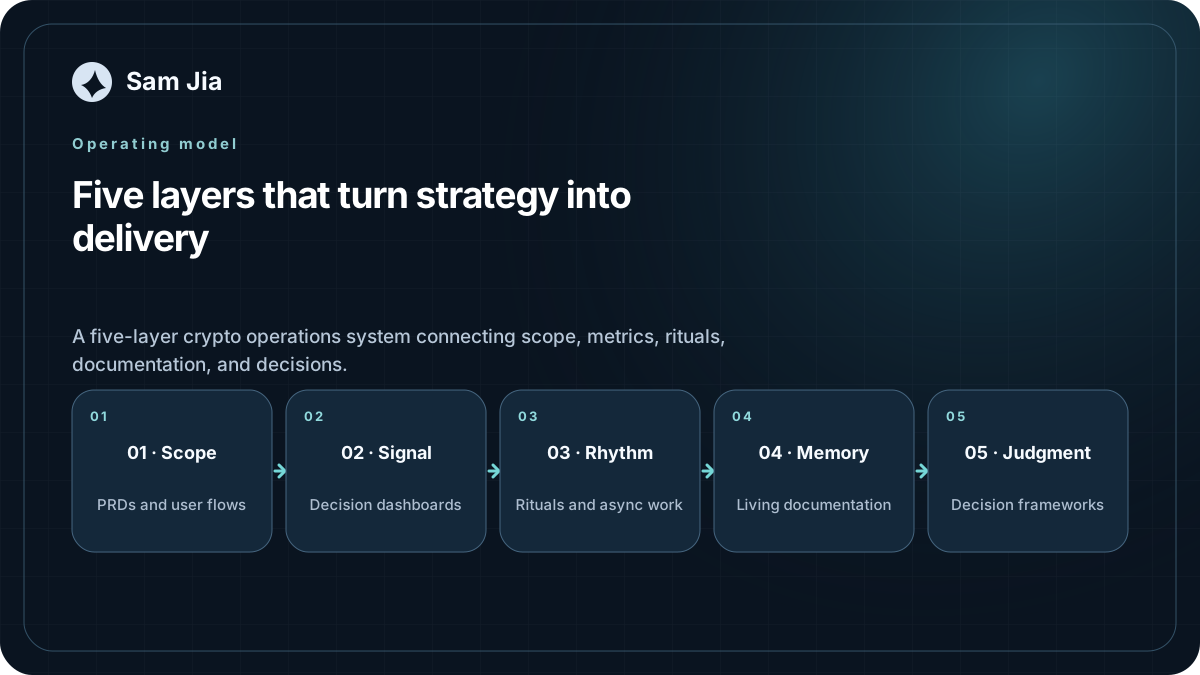
- A working crypto operations framework has five interlocking layers: PRDs and scope discipline, decision-driving dashboards, async-first rituals, documentation as operating system, and decision frameworks for uncertainty.
- The 30-minute ops review can replace 3+ hours of status meetings — but only if the information architecture is built before the meeting starts.
- Remote-first crypto teams need to treat documentation not as record-keeping but as the actual operating system of the company — handoff notes, decision logs, and scope boundaries are infrastructure, not admin.
- Operations isn’t overhead. It’s the competitive advantage most crypto teams ignore while blaming “execution” for strategy failures.
Why Crypto Operations Breaks Traditional Frameworks
Before you can build an operating system for a crypto team, you need to understand why standard frameworks — the kind taught in MBA programs or borrowed from SaaS — fail here. The constraints are genuinely different.
24/7 Markets, Global Teams, No Headquarters
Crypto markets never close. Your team might have contributors in Singapore, Lisbon, New York, and Buenos Aires. When a market event happens at 3 AM your time, the person who needs to respond might be the community manager in a time zone you haven’t thought about since last month’s onboarding.
Traditional operations assumes co-location, synchronous hours, and predictable escalation paths. Crypto operations assumes the opposite. The framework has to work when no two team members are awake at the same time.
I learned this the hard way at aelf, where I was on-site inside a crypto team — one of the few periods where I wasn’t remote. Even then, with most of the team in one building, the contributors who mattered most (validators, community moderators, ecosystem partners) were distributed across continents. The team’s operating rhythm worked inside the office and broke completely at the boundary. That experience shaped how I now think about crypto product operations: if your system only works when people are in the same room, you don’t have a system. You have a habit.
Regulatory Uncertainty as an Operating Constraint
SaaS teams plan quarters. Crypto teams plan until the next regulatory headline.
This isn’t just a legal problem. It’s an operations problem. When the rules can shift mid-sprint, your scope discipline, your decision frameworks, and your ability to re-prioritize without demoralizing the team become the difference between surviving a cycle and burning out during it.
Most teams respond to regulatory uncertainty with paralysis — everything becomes “wait and see.” The teams that move instead build decision frameworks that distinguish between reversible and irreversible commitments. More on that in Layer 5.
Community as Co-Operator: The Web3 Twist
In Web2, operations is mostly internal. In Web3 project management, your community isn’t just an audience — they’re an operating layer. They report bugs faster than your QA. They produce content that outperforms your marketing team. They form governance factions that shape your roadmap.
This means your blockchain team operations framework has to account for an organizational boundary that’s intentionally porous. The community doesn’t report to you, but they affect your execution velocity more than most employees do.
I’ve seen a single Discord thread from a community member redirect an entire sprint — not because the team was disorganized, but because the signal was genuinely more important than what was on the roadmap. That’s not a failure mode. It’s a feature of the space. But it only works if your operating system can absorb unstructured input without collapsing into reactivity.
The Operator’s System: Five Interlocking Layers
Here’s the core of the crypto operations framework. Five layers. Each one depends on the layer before it. Skip one, and the others become fragile.
Layer 1 — PRDs, User Flows & Scope Discipline
Most crypto teams skip PRDs. They ship from a Notion bullet list, a Telegram message, or — worst of all — a founder’s verbal description that no one wrote down. Then they’re surprised when the feature that ships doesn’t match what anyone expected.
A PRD (Product Requirements Document) is not bureaucracy. It’s a scope contract. At minimum, a crypto PRD should answer five questions:
- What user problem does this solve, and how do we know it’s real? (Not “what feature are we building,” but “what tension are we resolving.”)
- What’s explicitly out of scope? (The most important section. Scope discipline is defined by what you refuse to build.)
- What’s the user flow from entry to outcome? (Mapped, not described. If you can’t draw it, you don’t understand it.)
- What are the success criteria and who measures them? (Not “shipped in production.” Shipped and validated.)
- What dependencies or external assumptions does this rely on? (Contract audits, partner integrations, market conditions.)
a16z Crypto Startup School’s session on products and protocols reinforces the same product discipline: start with the user need, then decide which layers of the stack must be controlled to deliver the right experience.
In one team I worked with — let’s call them a DeFi protocol that had just raised — the “roadmap” was a Miro board with 47 sticky notes. No priorities. No scope boundaries. No one could tell you what was shipping this week versus next quarter. Engineers were working on things the marketing team had never heard of. Marketing was promoting features that hadn’t been scoped.
We didn’t solve this with more meetings. We solved it with a single PRD template enforced across every feature request. The rule was simple: if it’s not in a PRD, it’s not in a sprint. Within three weeks, the team’s shipping velocity didn’t just improve — the right things started shipping, because the act of writing a PRD forced the prioritization conversation that was never happening.
This is the kind of operational clarity I bring as a Fractional Operator for crypto teams. If your roadmap is a suggestion rather than a system, let’s talk about what a 2-4 week positioning and execution sprint could look like →
Layer 2 — Dashboards & Metrics That Actually Drive Decisions
Crypto teams love dashboards. Dune. Nansen. Token Terminal. Internal analytics. The problem isn’t lack of data. It’s that most dashboards are built for looking at, not deciding from. Dune’s documentation separates the work of composing and sharing decision dashboards from building programmatic analytics with its Data API; a useful operating system needs to decide which job it is solving.
A decision-driving dashboard has three properties:
- It surfaces variance, not just levels. “TVL is $47M” is a level. “TVL is 12% below the 30-day trend with no corresponding market event” is a signal.
- It’s linked to a specific decision. If the metric moves, someone’s action should change. If no decision would change based on the number, the number doesn’t belong on the dashboard.
- It has an owner who reviews it at a fixed cadence. Unreviewed dashboards are digital wallpaper.
Here’s what I mean by “linked to a specific decision.” During my time supporting product operations at DeSyn Lab, we had a set of metrics that looked comprehensive — TVL, user growth, retention cohorts, gas consumption by function. But in the weekly ops review, only three questions were actually driving decisions:
- Is our retention curve improving or degrading week-over-week? → Determines whether we invest in onboarding fixes or proceed with planned features.
- Which function is consuming disproportionate gas? → Signals bugs, UX friction, or unexpected user behavior patterns.
- Are new users coming from organic channels or campaigns? → Determines whether our narrative is working independently of paid push.
Everything else on the dashboard was noise. We removed it. The weekly review went from 90 minutes to 30. The quality of decisions went up because there were fewer numbers to argue about and more clarity on what each number was asking us to do.
Layer 3 — Rituals, Meetings & Async Communication
Here’s the counter-intuitive insight most teams resist: the goal of meetings is to make future meetings unnecessary.
Most crypto teams run too many syncs and too few structured rituals. A “ritual” is different from a meeting. A meeting is a calendar event. A ritual is a recurring checkpoint with a fixed agenda, fixed inputs, and a fixed decision output.
My minimum viable ritual set for a crypto operations framework:
| Ritual | Cadence | Duration | Fixed Input | Decision Output |
|---|---|---|---|---|
| Ops Review | Weekly | 30 min | Dashboard snapshot, PRD status board | Scope changes, resource shifts, escalation flags |
| Narrative Check | Bi-weekly | 45 min | Campaign metrics, community sentiment summary, competitor positioning | Messaging adjustments, proof priorities |
| Retro | Bi-weekly | 45 min | Pre-collected friction points (async, before the call) | Process changes, documentation updates |
| Decision Review | Monthly | 60 min | Decision log from the month, outstanding reversible/irreversible calls | Ratify or reverse prior decisions |
The key: inputs are assembled before the ritual. The ritual is for deciding, not for discovering. If someone is reading a dashboard for the first time during the ops review, the ritual has already failed.
Layer 4 — Documentation as Operating System
In a remote-first crypto team, documentation isn’t a knowledge base. It’s the operating system.
GitLab calls this handbook-first communication: put durable information in the shared source of truth first, then use chat and meetings to discuss it.
When you don’t share an office, you share documents. And when those documents are incomplete, outdated, or scattered across five tools, the team’s operating system crashes. Not dramatically — it degrades quietly. People make assumptions. Decisions get made twice. Handoffs fail.
The documentation layer of blockchain team operations needs three things:
Decision logs. Every significant decision — scope change, timeline shift, narrative adjustment — gets logged with date, context, decider, and reasoning. Not for posterity. For the teammate in Singapore who wakes up six hours after the decision was made and needs to know what changed and why without pinging someone who’s asleep.
Handoff notes. When work moves from one person to another — from product to engineering, from marketing to community, from sprint finished to sprint next — there’s a structured handoff. Context, current state, known issues, next decision point. Nothing fancy. Just consistent.
Living PRDs. A PRD isn’t finished when development starts. It gets updated with decisions made during implementation, scope changes, and post-launch findings. The artifact evolves because the understanding evolved.
If your team’s documentation is scattered across Notion, Slack, Telegram, and someone’s DMs, you don’t have an operating system — you have institutional amnesia. I help teams build documentation infrastructure that actually gets maintained. See how a Fractional Operator engagement works →
Layer 5 — Decision Frameworks for High-Uncertainty Environments
This is the layer most crypto operations frameworks skip. They cover processes and dashboards but never address the actual quality of decisions when the information is incomplete — which in crypto, it always is.
The framework I use distinguishes two types of decisions:
Type 1: Reversible decisions. Can be undone with acceptable cost within a reasonable timeframe. These should be made fast, by the person closest to the information, with light documentation. Speed matters more than perfect accuracy.
Type 2: Irreversible decisions. Cannot be easily undone. Protocol upgrades, token economic changes, major partnership commitments, public positioning shifts. These need structured deliberation: written proposal, explicit tradeoffs, a named decider, and a decision deadline.
Most crypto teams treat every decision as Type 2 — everything goes through the founder, everything needs alignment, everything takes too long. The result isn’t better decisions. It’s slower decisions, which in a 24/7 market is itself a decision about velocity.
I once worked with a team where the founder reviewed every blog post, every tweet thread, every partnership announcement. The approval queue was 11 items deep on an average Tuesday. The marketing team was frozen. We implemented a simple rule: anything reversible (content, campaign angles, community responses) requires one peer review. Anything irreversible (positioning changes, token-related communications, crisis responses) requires founder sign-off. The content output doubled in two weeks. Quality didn’t drop — it improved, because the team started treating reversible decisions as learning opportunities rather than career risks.
From Strategic Intent to Weekly Cadence
A crypto operations framework is only as good as the translation layer between “what we believe” and “what we do this week.” Most teams have a strategy offsite once a quarter. The output is a deck. Then everyone goes back to their daily work and nothing changes.
The Narrative-to-Operations Translation Layer
Here’s how the translation actually works. Take a strategic statement like:
“We believe the market is moving toward intent-based execution, and our protocol should be the default settlement layer for that shift.”
That’s a belief. Here’s what it looks like when translated into crypto product operations:
| Translation Step | Operational Question | Action |
|---|---|---|
| Audience | Who needs to believe this first? | Prioritize builders and solvers over retail users in Q3 campaigns |
| Proof | What evidence supports this? | Ship a solver integration case study, publish benchmark data |
| Product | What does our product need to do to make this credible? | Prioritize solver SDK documentation over new UI features |
| Campaign | What campaign tests this narrative? | Run a solver-focused hackathon, not a general ecosystem grant program |
| Rejection | What audience or use case are we explicitly deprioritizing? | Retail yield aggregators — not our focus this quarter |
Every belief gets this treatment. If a belief doesn’t change any operational decision, it’s not a strategy — it’s decoration.
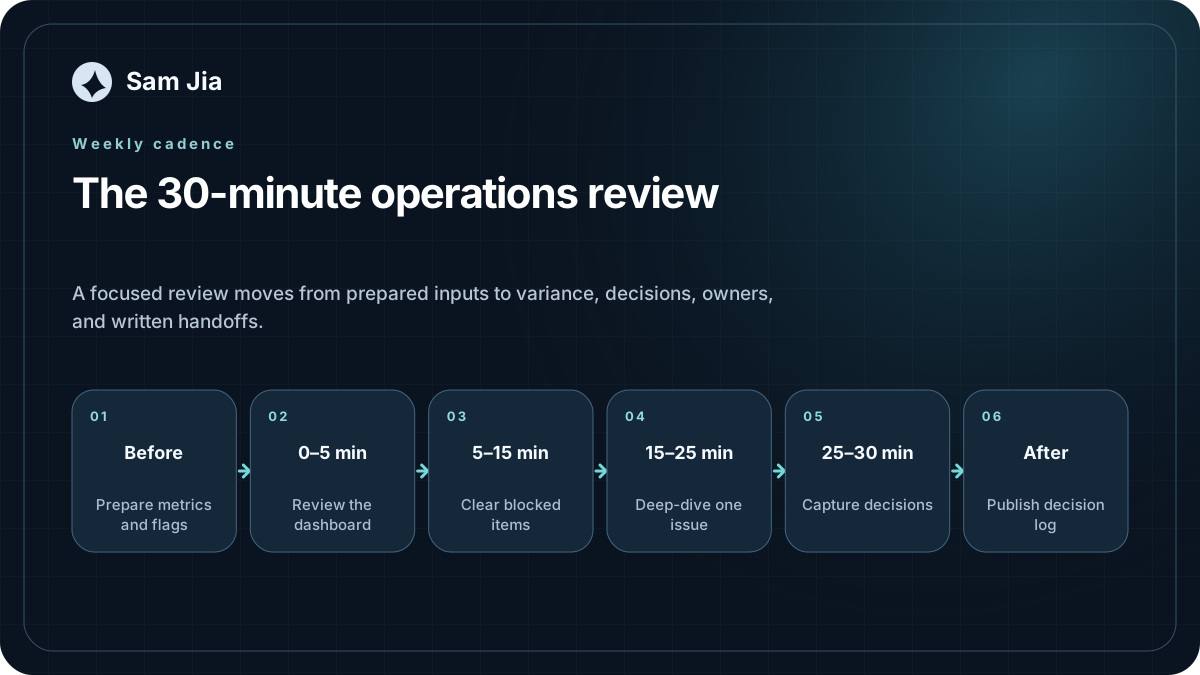
How to Run a 30-Minute Ops Review That Replaces 3 Hours of Meetings
Here’s the exact structure I use. It works because the inputs are assembled before the room opens.
Pre-work (async, before the review):
- Dashboard snapshot posted to a fixed channel (not emailed, not in a Slack thread that gets buried)
- PRD status board updated — each active PRD marked as on-track, at-risk, or blocked with one-line explanation
- Decision log from the past week summarized — what was decided, who decided it, what changed
The 30-minute structure:
- Minutes 0–5: Dashboard scan. Three metrics only. Everyone reads before speaking. Questions are about variance from trend, not absolute numbers.
- Minutes 5–15: Blocked and at-risk items. Only discuss things that need a decision. No status updates — those were in the async pre-read. If nothing is blocked, skip this segment.
- Minutes 15–25: One deep-dive topic. Rotating. One week it’s retention, next week it’s campaign performance, next week it’s a specific feature’s adoption curve. One topic, one decision at the end.
- Minutes 25–30: Decision capture and next review prep. What was decided, who owns follow-up, what’s the deep-dive topic for next week.
That’s it. A crypto startup operations playbook doesn’t need to be complex. It needs to be consistent. The consistency is the hard part.
Remote-First Operations: What 5+ Years Taught Me
I’ve been remote-first since January 2020. Before it was normalized. Before every crypto team had a “distributed-first” line in their job descriptions. What I’ve learned is that remote work doesn’t fail because of technology. It fails because of visibility asymmetry and handoff friction.
Async-First Documentation Culture
“Async-first” is a phrase people use and rarely practice. It doesn’t mean “send messages and hope people read them.” It means: the information required for someone to make a decision or execute a task is available to them without having to ask for it.
GitLab’s asynchronous communication guide makes the same standard concrete: include full context, make the next action explicit, and write for teammates who will read it in another time zone.
This requires discipline that most teams don’t have:
-
Decisions must be written down with reasoning, not just outcomes. “We’re pushing the launch by two weeks” is an outcome. “We’re pushing the launch by two weeks because the audit found a medium-severity issue in the withdrawal function, and the fix requires a contract redeployment” is context. The teammate in a different time zone needs context to make their own downstream decisions.
-
Status updates must be structured, not narrative. “Working on it, making progress” is noise. “PRD-14: on-track, 80% complete, no blockers, ETA Thursday” is signal. This seems obvious. Almost no team does it consistently.
-
Reading documents is real work. If your team treats “spent the morning reading PRDs and decision logs to get context” as unproductive time, your async culture is performative.
I build AI-native workflow infrastructure for crypto teams that want documentation to be a system, not a burden. Explore how an AI workflow audit can reduce your team’s coordination overhead →
Trust, Visibility, and Handoffs Across Time Zones
The hardest operational problem in a remote crypto team isn’t communication. It’s handoffs.
When you’re co-located, handoffs are ambient. You can see when someone is deep in work. You can tap them on the shoulder with a quick question. You absorb context passively.
When you’re remote across time zones, every handoff is a hard cut. The person handing off is asleep when the person receiving starts their day. If the handoff is missing one piece of context — one assumption, one edge case, one “obvious” next step — the receiver loses half a day figuring it out or waiting for a reply.
The fix is a handoff protocol that takes five minutes:
- Current state: What’s done, what’s in progress, what’s blocked.
- Next action: The specific thing the receiver should do first. Not a list. One action.
- Decision boundary: What the receiver can decide on their own vs. what requires escalation.
- Where to find it: Links, not descriptions. “The PRD is in the ops folder” is a description. A URL is infrastructure.
Case Study: Building Operations Inside a Crypto Team
Let me walk through a real engagement — anonymized, but the pattern is accurate.
The Initial Chaos
A DeFi protocol, post-raise, about 18 contributors. The team had:
- A roadmap that existed as a founder’s mental model, partially reflected in a Notion page that was three months out of date
- Standup meetings that ran 45+ minutes, where people recited what they did yesterday with no reference to any dashboard or PRD
- Three different project management tools because different sub-teams had different preferences
- Marketing producing content for features that engineering had deprioritized two weeks earlier without telling anyone
- No one who could answer the question “what’s shipping this week?” without asking three other people
The founder was burned out from being the only person holding the operational context together. Every decision flowed through him — not because he wanted control, but because no one else had the full picture.
What Fixed It
We didn’t rebuild everything. We installed the five layers, one at a time, in sequence:
Week 1–2: PRD template enforced. Every feature request, every campaign, every content initiative required a PRD before anyone could start working on it. The template was deliberately simple — five sections, max two pages. The discipline of writing before building immediately surfaced the misalignment between marketing and engineering. Half the “active” features turned out to have no owner and no clear scope. They were either assigned or killed.
Week 3–4: Dashboard rebuild. Cut the metrics from 23 to 7. Each metric linked to a specific decision. Each metric had a named owner. The weekly ops review shifted from “here’s what happened” to “here’s what we’re deciding.”
Week 5–6: Ritual reset. Standups moved to async (one Slack message per person, structured format, posted by 10 AM). The 30-minute ops review replaced the 90-minute status meeting. The decision log was introduced — initially just a shared document where every significant call got a one-paragraph entry.
Week 7–8: Documentation infrastructure. PRDs moved from static documents to living ones. Handoff templates were introduced. The “operating manual” — a single document describing how the team works, where things live, and how decisions get made — became the onboarding artifact for new contributors.
Before/After
The measurable outcomes after eight weeks:
- Weekly ops review: 90 minutes → 30 minutes
- Features shipped per sprint: 3 → 7 (same team size, clearer scope boundaries)
- Misaligned work discovered mid-sprint: 4–5 items → 0–1
- Founder decision load: Reduced by roughly 60% (measured by number of decisions requiring founder input per week)
- New contributor onboarding time: ~2 weeks → ~4 days (because the operating manual and decision log provided context that previously lived in people’s heads)
The qualitative shift was more important. The team stopped feeling like they were constantly catching up. They knew what they were doing, why they were doing it, and what needed to happen next. That’s what a crypto operations framework is supposed to produce: not just efficiency, but clarity.
Conclusion: Operations Isn’t Overhead
Here’s the thesis that most crypto teams resist, and the one I’ve built my career on: operations isn’t overhead. It’s the competitive advantage.
The industry talks endlessly about technology moats — faster consensus, better ZK proofs, more capital-efficient AMMs. Those matter. But the teams that survive multiple cycles aren’t just the ones with the best technology. They’re the ones with the best operating systems.
Because here’s what happens when you don’t have a crypto operations framework:
- Your roadmap is a wishlist, not a plan.
- Your meetings are discovery sessions, not decision forums.
- Your documentation is archaeology — digging through old Slack threads to reconstruct context.
- Your remote teammates operate in information silos and feel it.
- Your community feedback enters a black hole with no structured response path.
- Your founder burns out from being the only integration point.
And here’s what happens when you do:
- Strategy changes what the team does on Tuesday morning.
- Dashboards drive decisions, not just awareness.
- Meetings shrink, information quality rises.
- Handoffs work across time zones because the context is in the system, not in someone’s head.
- The team moves faster with fewer coordination costs.
The crypto operations framework I’ve described here — five layers, translation discipline, remote-first rituals, structured handoffs — isn’t theoretical. It’s what I’ve built and refined across eight years, eleven public builds, and more execution-intensive environments than I can count.
If you’re a crypto founder or operations lead who recognizes the chaos described in this article, you don’t need more strategy. You need an operating system.
And if you want help building one — let’s talk.
Related reading
Continue the operating conversation
Get occasional notes on crypto operations, AI workflows, and growth systems. No spam. Unsubscribe anytime. Usually fewer than two emails per month.