The Crypto Go-to-Market System: From Positioning to First 100 Users
Most crypto teams spend six months building their product and six days on their crypto go-to-market strategy. Then they wonder why nobody showed up.
I’ve watched this pattern repeat across eight years of building and launching in crypto — from Layer 1 infrastructure at aelf to DeFi protocols at Berry Data and DeSyn Lab, and across the dozens of projects I’ve advised or operated. Every failed launch had one thing in common: a crypto go-to-market strategy that existed only in the founder’s head, never on paper, never tested. The script is always the same: brilliant engineering, zero distribution strategy. A whitepaper that took 12 drafts. A launch plan scribbled on a Notion page the week before TGE.
Here’s what those teams don’t realize until it’s too late: CoinGecko’s 2026 review found that 53.2% of all cryptocurrencies listed on GeckoTerminal had failed, with 86.3% of the failures recorded between 2021 and 2025 occurring in 2025. The dataset does not assign a cause. In the launches I’ve observed, the recurring operational problem is go-to-market sequencing — teams doing the right things in the wrong order, or worse, doing the wrong things with conviction.
This article is the crypto go-to-market strategy framework I’ve built from operating through those failures and the few clean launches. It’s not theory. It’s what survived contact with real deadlines, incomplete data, and the chaos of actual market conditions.
Key Takeaways
- CoinGecko found that 53.2% of GeckoTerminal-listed cryptocurrencies had failed; in my experience, weak launch sequencing is one of the recurring operational causes
- Your narrative isn’t your whitepaper thesis. It’s the three words a stranger says when they hear your project name for the first time
- Pre-launch (T-30) is a high-leverage window most teams ignore — community priming done here gives launch-week distribution somewhere useful to land
- Founder-led content often carries stronger operator signal than generic agency copy, yet many teams outsource their voice before they’ve established one
- A weekly operating rhythm of narrative → content → distribution → feedback turns GTM from a one-time campaign into a compounding system
Why Most Crypto GTM Strategies Fail Before Launch
The product-first fallacy in Web3
I sat in a war room in 2021 with a DeFi protocol team that had just finished a $2M seed round. The product was elegant — smart contracts audited by two firms, a liquidity architecture that genuinely improved on the existing AMM model. The launch plan was a Telegram group with 400 members and a single Medium post scheduled for TGE day.
“Build it and they will come” is dangerous advice in any industry. In crypto, it’s a death sentence.
The broader market signal is sobering: CoinGecko’s dataset shows how quickly large numbers of listed cryptocurrencies become inactive. It does not diagnose why individual projects fail. The recurring web3 launch strategy failure I have observed is teams treating distribution as an afterthought instead of a core function that begins the day the product spec is written.
Here’s the counter-intuitive truth most founders resist: your product doesn’t need to be perfect before you build audience — but your narrative does need to be clear before anyone will care. The teams I’ve seen win didn’t build longer. They talked to users earlier, shipped uglier MVPs, and iterated in public while their competitors were polishing in private.
Narrative without execution = noise
Every crypto conference, every Telegram AMA, every pitch deck — the same words appear: “decentralized,” “permissionless,” “community-owned,” “next-generation.” These words have been used so many times they now mean precisely nothing.
A narrative is not a tagline. It’s the answer to one question: “Why does this project deserve to exist, and who specifically cannot live without it?”
Most teams can’t answer this. They describe what they built, not why it changes anything. Their “positioning” is a list of features dressed up as a vision statement.
When I worked on the GTM for Berry Data, the initial pitch was “a transparent oracle solution on BSC.” Technically accurate. Strategically useless — there were already three oracle projects on BSC saying the same thing. The repositioning wasn’t about being more transparent. It was about being the oracle that aggregators and yield optimizers could integrate in under 24 hours — speed as the wedge, transparency as proof. That specific, narrow claim gave us something real to build content around, find early users for, and measure.
The missing operating rhythm
The third failure mode is subtler. These teams do have a plan. They scheduled their KOL posts. They booked their CoinDesk feature. They have a launch week calendar that looks busy.
But there’s no engine underneath it. No weekly cadence of narrative sharpening, content production, distribution, and feedback digestion. The launch is a one-time sprint, not the first cycle of an operating system that keeps running.
“Strategy is most useful when it survives contact with deadlines, incomplete data, and real operating constraints.”
That’s the line I use with every team I work with, because it’s what separates a crypto marketing strategy that compounds from one that flames out after two weeks. If your GTM can’t run on a Tuesday morning when the KOL you booked ghosted and the CEX pushed your listing by three days, it’s not a strategy — it’s a wish list.
The Four-Layer Crypto GTM Framework
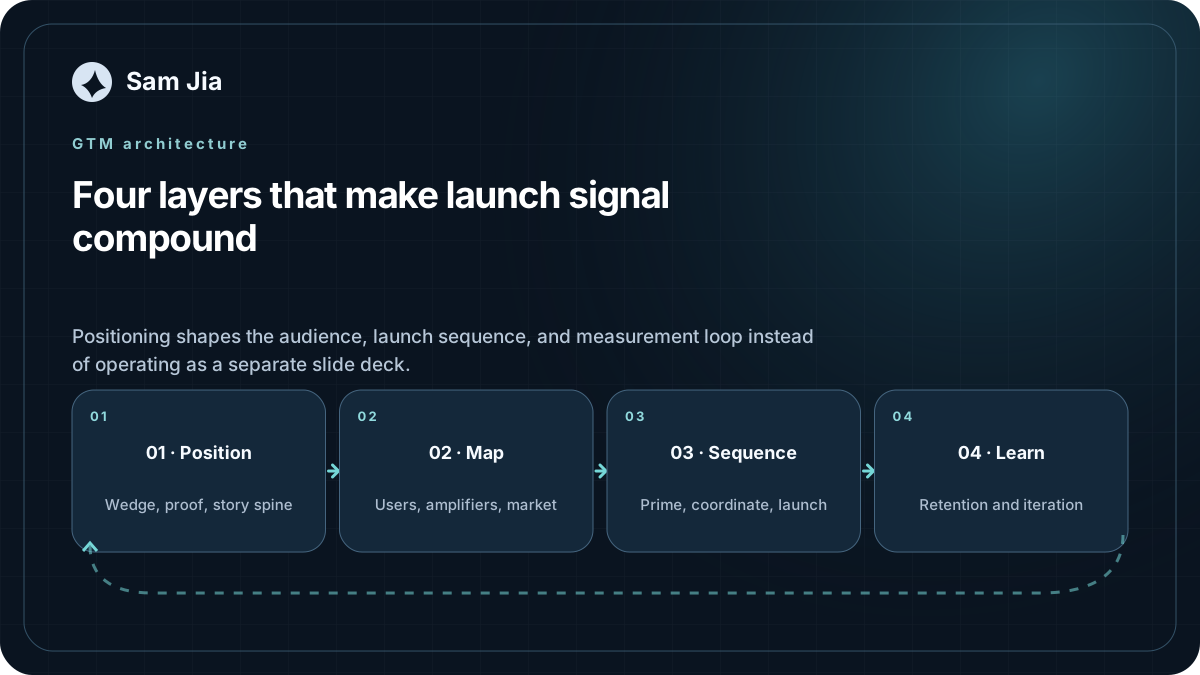
After eight years of launches across L1s, DeFi protocols, and data platforms, I’ve compressed what works into four layers. Each layer feeds the next. Skip one, and the whole stack wobbles.
The structure is crypto-specific. a16z’s guide to go-to-market in Web3 is a useful primer on why tokens, community participation, and decentralized organizations change the distribution model rather than simply adding another channel to a traditional funnel.
Layer 1 — Positioning & Narrative Architecture
Positioning answers: what do you own in the mind of your user that no competitor can claim?
Most crypto projects skip this entirely. They write a whitepaper that explains their mechanism, then call that positioning. But a whitepaper is internal logic. Positioning is external differentiation.
The test I use with every team: if I wake up your ideal user at 3 AM and ask what your project does, they should be able to answer in one sentence. Not “it’s a modular interoperability layer for cross-chain liquidity aggregation.” That’s 12 syllables too long. Something like “it’s the Stripe for moving assets between L2s” — inaccurate in the details, accurate in the mental model, and that’s the point.
Your positioning needs three components:
- The wedge: one narrow use case you win at decisively
- The proof: evidence you can actually deliver (testnet data, case studies, operator credentials)
- The story spine: the narrative arc that makes people want to track your progress
The a16z State of Crypto 2025 report is a useful external check on that story spine: broad market narratives only become useful when a team can connect them to a specific user behavior and proof point.
Layer 2 — Audience & Community Mapping
Not everyone who might use your product is your early adopter. Most teams draw a giant circle around “DeFi users” or “institutional capital” and call it audience mapping. That’s not mapping. That’s hoping.
Real audience mapping means identifying:
- The 50 people who will try your product within 48 hours of launch because the specific problem you solve is their daily headache
- The 500 people who will amplify your narrative because it validates their own thesis about where the market is going
- The 5,000 people who will show up if the first two groups create enough signal
Working at DeSyn Lab taught me this the hard way. We launched a decentralized synthetic asset protocol and initially targeted “everyone interested in on-chain derivatives.” That’s not a segment — that’s half of DeFi Twitter. Real traction came when we narrowed to yield farmers on emerging L2s who needed synthetic exposure to assets that hadn’t bridged yet. A few hundred people. But every single one of them had a reason to use the product on day one.
Layer 3 — Launch Sequencing & Campaign Design
Sequencing is where most crypto go-to-market strategy execution breaks. Teams do the right activities in the wrong order and wonder why the momentum doesn’t stack.
The principle is simple: signal compounds when it arrives in the right sequence; noise compounds when everything arrives at once.
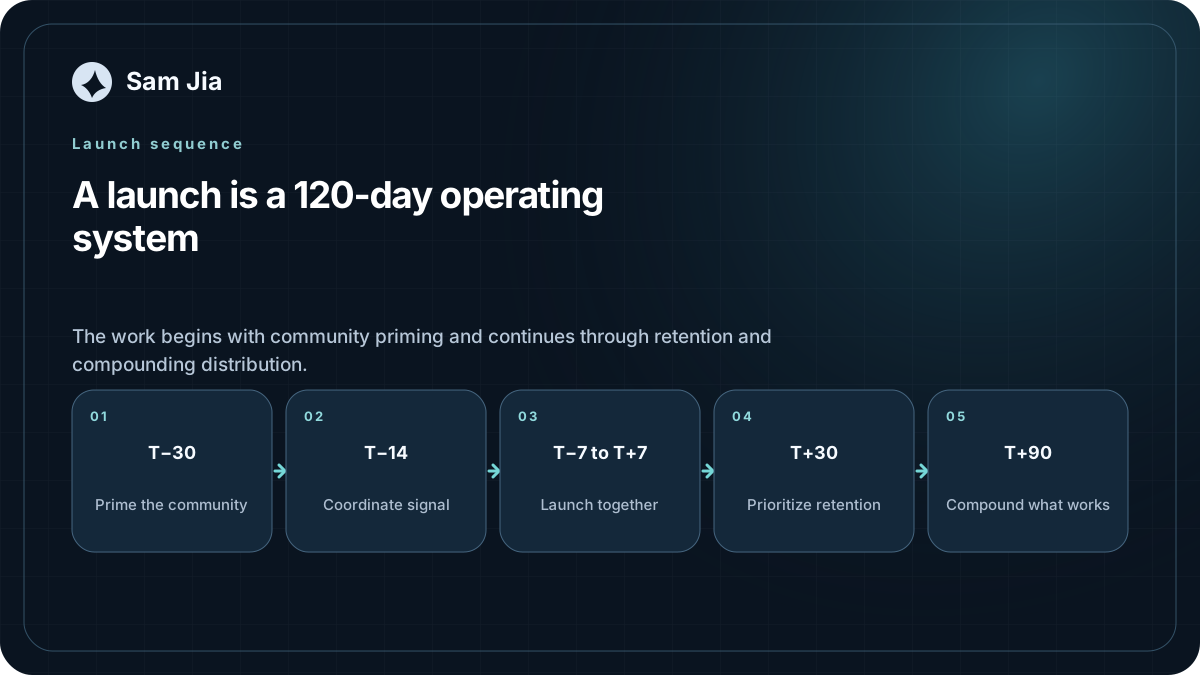
A well-sequenced launch looks like this:
- Community priming (T-30 to T-14): testnet incentives, founder content, early adopter onboarding
- Signal coordination (T-14 to T-7): KOL briefings, PR embargoes, exchange listing confirmations
- Launch week (T-7 to T+7): coordinated announcements, not scattered posts
- Retention ramp (T+7 to T+30): content cadence, community rituals, product iteration based on real feedback
Any web3 launch strategy that skips community priming and jumps straight to KOL activation is paying for eyeballs that land on an empty room. The sequence matters more than the activities themselves.
Layer 4 — Measurement & Iteration Loops
Most crypto teams measure the wrong things: Telegram member count, Twitter impressions, CMC watchlist adds. These are vanity metrics that tell you nothing about whether your GTM is working.
The metrics that matter:
- DAU retention on Discord/Telegram at 7, 30, and 60 days post-launch
- Unique active wallets interacting with your protocol (30-day rolling)
- Governance participation rate (if applicable)
- Inbound collaboration requests — the truest signal that your narrative is traveling
Token price is the worst standalone GTM metric. It lags narrative, amplifies noise, and punishes good decisions made at the wrong macro moment. If you’re optimizing GTM for token price, you’re optimizing for the wrong variable.
Even wallet activity needs context. DefiLlama’s API documentation makes the scope and shape of its protocol data inspectable; the operating lesson is to record which definition and endpoint produced a metric instead of treating a dashboard label as self-explanatory.
Positioning That Survives Market Contact
From whitepaper thesis to market message
Your whitepaper thesis is internal. Your market message is external. They serve different functions and should look different.
A whitepaper thesis explains how something works. A market message explains why someone should care. The first is a mechanism. The second is a promise.
The translation process I use with teams:
- Write your whitepaper thesis in one paragraph. (Most teams already have this.)
- Identify the single most painful problem it solves. Not “improves efficiency by 15%” — something the user currently curses at on a Tuesday afternoon.
- Name the specific person who has that problem. Not a persona. A real person, or a real type of person you can find in a Discord server.
- Write the market message as if you’re explaining to that person, over coffee, why they should care.
At TrueChain, the whitepaper thesis was about hybrid consensus mechanisms combining PoW and DPoS. The market message that actually landed was simpler: “Ethereum-compatible smart contracts at a fraction of the gas cost, today.” The thesis hadn’t changed. But the message had gone from describing a mechanism to solving a specific, felt problem.
This translation process — from technical thesis to market message — is what separates effective crypto narrative marketing from whitepaper regurgitation. Most projects skip it entirely, assuming the market will connect the dots on its own. It won’t.
The “wedge” approach: narrow entry, expand later
Crypto projects love to be platforms. “We’re building the infrastructure layer for the next generation of decentralized applications.” That’s not positioning. That’s a blank check written against future hope.
The projects that survive start as a sharp wedge — one thing, done decisively better — and expand only after that wedge has penetrated.
Uniswap started as “swap any two ERC-20 tokens.” Not “the decentralized exchange protocol powering the future of finance.” Aave started as “lend and borrow crypto assets.” Not “the liquidity layer for DeFi 2.0.”
Your wedge needs three qualities:
- Specific enough that a stranger can describe it after one exposure
- Valuable enough that the first 50 users switch immediately
- Expandable enough that winning the wedge creates a path to the platform
Case study: the 2-week repositioning
In early 2023, I worked with a DeFi yield protocol that had spent four months in development but couldn’t get traction. Their positioning was “optimized yield aggregation across multiple chains” — accurate, complete, and utterly forgettable.
The problem: Every yield aggregator says this. The market had no reason to distinguish them from Yearn, Beefy, or any of the 20+ alternatives.
The repositioning sprint (what we did in 2 weeks):
- Day 1-3: Interviewed 12 active users of competing yield aggregators. Found a pattern: the #1 frustration wasn’t APY — it was the time between depositing and seeing the first confirmed yield. Most protocols took 24-48 hours for the first harvest.
- Day 4-5: Analyzed the protocol’s actual architecture. Discovered their vault design could confirm and compound yields in under 4 hours — a genuine technical advantage they’d never emphasized because they were too busy describing their “multi-chain architecture.”
- Day 6-10: Rewrote every piece of public-facing copy around one claim: “See your yield in 4 hours, not 48.” Simplified the website from six pages to three. Cut the whitepaper summary from 800 words to 200.
- Day 11-14: Relaunched the Twitter presence around this single wedge. Every post, every thread, every AMA answer reinforced the same claim. Within 30 days of the repositioning, TVL 4x’d — not because the product changed, but because the market finally understood why it existed.
The lesson isn’t “find a speed advantage.” It’s: your market message is hiding in the thing your team takes for granted because it’s too close to the code.
Launch Sequencing: What to Ship When
Pre-launch (T-30 days): community priming
This is the highest-leverage window in the entire GTM timeline. It’s also the one most teams skip entirely.
The goal of pre-launch isn’t to build hype. Hype attracts tourists, and tourists leave. The goal is to build a core group of 50-200 early users who understand what you’re building, have tried the testnet, and will be your distribution layer on launch day.
What to do in T-30 to T-14:
-
Ship a testnet with real incentives. Not “earn points for clicking buttons.” Give testnet users a reason to understand your product deeply. At CoinWind, we ran a testnet competition where the top 20 participants — judged on the quality of their feedback, not transaction volume — received early access plus a token allocation. The feedback from those 20 users caught three bugs and surfaced two UX improvements we’d completely missed.
-
Publish 2-3 pieces of founder-led content that articulate your thesis, your wedge, and the problem you’re solving. Not press releases. Not “we’re excited to announce.” Real, specific content that someone in your target audience would forward to a colleague.
-
Start DM conversations with your target 50 users. Not mass outreach. Individual, researched DMs that reference their existing work or interests. At DeSyn Lab, my co-founder and I personally DMed 80 DeFi power users on L2s, referencing specific tweets they’d written about synthetic assets. 31 responded. 18 joined our early tester group. Those 18 people became our most reliable distribution channel.
-
Set up your measurement infrastructure now, not post-launch. Discord analytics, on-chain activity tracking, content engagement baselines. You can’t measure what changed if you don’t know where you started.
Launch week: coordinated signal, not scattered noise
The most common launch week mistake: announcing everything at once in a desperate attempt to look like “momentum.” Exchange listing, partnership, product launch, token generation — all on the same day. The result is that no single message lands, because the audience’s attention budget was exhausted in the first 30 minutes.
The launch week rule: one primary signal per day, and every signal must reference the one before it.
A clean launch week sequence:
- Day 1: Product goes live. One announcement thread. That’s it.
- Day 2: User stories. Screenshots of real deposits, real yields, real activity. Social proof, not more announcements.
- Day 3: Founder thread or interview on why this exists — narrative depth, not feature depth.
- Day 4: Community amplification day. Spotlight content from early users. Make them the story.
- Day 5: Exchange or partnership announcement (if applicable). By now, there’s actual activity to point to, which makes the announcement credible.
- Day 6-7: Reflection content. What we learned. What’s next. Open loop that keeps people coming back.
The counter-intuitive launch insight: silence between announcements is not wasted time. It’s processing time for your audience. If you’re publishing 8 announcements a day, you’re training people to ignore you.
Post-launch (T+30 days): retention over vanity metrics
TGE is not the finish line. For most projects, TGE is where the real work begins. If your GTM strategy ends at launch, you have no operating system for turning short-term attention into durable participation.
That is why a16z’s token launch readiness guide treats product-market fit and operational readiness as prerequisites: a token can accelerate an existing system, but it cannot create durable demand on its own.
The post-launch retention framework:
T+1 to T+7: Celebrate and signal.
- Publish a public analysis of launch metrics within 24 hours. Transparency builds trust faster than perfection.
- Ship the first post-launch product update based on real user feedback — nothing builds retention like “you complained, we fixed it.”
- Recognize your early community publicly. Specific callouts, not generic thank-yous.
T+7 to T+30: Deepen the narrative.
- Shift from launch narrative to growth narrative. What’s the next milestone?
- Publish at least one thought leadership piece per week that extends your thesis.
- Begin governance or community contribution rituals that give users a stake in what happens next.
T+30 to T+90: Build retention mechanics.
- If your token has utility, make it operational now — staking, governance, fee sharing. Don’t wait.
- Launch contributor programs that convert passive users into active builders.
- Measure DAU retention at 30, 60, and 90 days. If retention is dropping, interview the leavers. Their reasons are your product roadmap.
Building a Content System That Compounds
One pillar, many spokes: the content topology
Most crypto content strategies are spray-and-pray: a Medium post here, a Twitter thread there, an AMA whenever someone remembers to schedule one. There’s no architecture. No compounding.
The content topology I use with every team:
- One pillar piece per week: a 1,500-3,000 word article, research report, or deep-dive thread that advances your core narrative. This is the root content.
- 3-5 spokes from the pillar: tweet threads, short-form video scripts, newsletter excerpts, community discussion prompts — all derived from the pillar, not written from scratch.
- Distribution across 3-5 channels: X (Twitter), Discord announcements, newsletter, relevant ecosystem forums, partner channels.
This isn’t about volume. It’s about leverage. One pillar piece generates a week of content without requiring a week of effort. The system compounds because each piece reinforces the last, building the narrative brick by brick instead of shouting it all at once.
Founder-led content vs. outsourced content
In the crypto teams I have operated with, founder-led content consistently produces stronger engagement and more useful replies than generic outsourced copy. Not because agencies are bad (some are excellent). Because crypto audiences have developed a sophisticated bullshit detector. They can tell when the person writing about permissionless composability has never deployed a smart contract.
This is the uncomfortable truth at the core of web3 growth marketing: authenticity compounds, and you can’t outsource it. You can systematize around it — structure, distribution, repurposing — but the signal has to come from someone who’s actually operated.
This doesn’t mean founders need to become full-time content creators. It means the content system should be architected by the founder’s thinking but executed through a lightweight production process.
The model I use:
- Founder provides: thesis, unique takes, data from operating, contrarian opinions
- Content system captures: through structured interviews, voice notes, or bullet-point outlines
- Production layer handles: formatting, distribution, repurposing into spokes
The founder spends 2-3 hours per week on content input. The system produces 5-7 pieces of content from that input. That’s the leverage.
AI-assisted content ops
I’ve written separately about building AI-native content workflows — the prompt chains, the quality gates, the handoff protocols. The short version: AI is a production accelerator, not a thinking replacement. Use it for formatting, research aggregation, distribution scheduling, and first drafts of content spokes. Never use it for core thesis development or anything that passes as original thought.
The principle I operate by: every piece of AI-assisted content must have a verifiable human input trail. If I can’t point to the specific founder interview, data source, or operator insight that generated a piece of content, it doesn’t ship.
The GTM Operating Rhythm
Weekly cadence: narrative → content → distribution → feedback
This is the engine. The weekly cycle that turns GTM from a launch campaign into a compounding system:
| Day | Activity | Output |
|---|---|---|
| Monday | Narrative review: what’s the one message we’re pushing this week? | 1-sentence narrative brief |
| Tuesday | Pillar content production: article, research, or deep-dive thread | 1 pillar piece |
| Wednesday | Spoke production: tweets, newsletter excerpt, community prompts | 3-5 spokes from pillar |
| Thursday | Distribution push: ecosystem forums, partner cross-posts, KOL amplification | Coordinated signal across channels |
| Friday | Feedback digest: what landed, what didn’t, what the community is saying | 1-page insights doc |
| Weekend | Rest. GTM is a marathon, not a sprint. | Recovery |
This isn’t aspirational. It’s the actual cadence I’ve run across multiple projects. The discipline is the point. A team that ships one clear message every week for 52 weeks will have more market presence than a team that does four chaotic launch campaigns a year.
Dashboard: what to measure, what to ignore
The dashboard I recommend tracking weekly:
| Metric | Why It Matters | Red Flag |
|---|---|---|
| Content engagement rate (per platform) | Measures narrative resonance | Declining 3+ weeks |
| Inbound DM/collab requests | Best leading indicator of narrative spread | Flat for 4+ weeks |
| Testnet/mainnet active wallets (30d rolling) | Real product traction | Declining while content engagement rises (content-product gap) |
| Community message sentiment ratio | Early warning system for narrative problems | Positive:negative ratio below 3:1 |
| Pillar-to-spoke production ratio | Measures content system efficiency | Below 1:3 (not extracting enough leverage) |
What to ignore: follower counts, CMC watchlists, “partnerships” that are just logo swaps, any metric where growth doesn’t correlate with real product usage.
When to pivot vs. when to double down
The hardest GTM decision: is the narrative not working because it’s wrong, or because it hasn’t had enough time?
Signals to pivot (within 30 days):
- Your content is getting impressions but zero engagement (the audience exists; the message doesn’t land)
- Inbound inquiries are about the wrong thing — people are interested in a feature you consider secondary
- Community conversations consistently orbit around a different problem than the one you’re solving
Signals to double down (within 30 days):
- A specific piece of content dramatically outperforms your baseline (3x+ engagement)
- A specific user segment shows disproportionate retention
- Inbound DMs reference the same 1-2 phrases from your narrative (it’s sticking)
Pivoting isn’t failure. Pivoting is the operating system working. The goal of the weekly cadence is to surface these signals fast enough that a 30-day pivot is a feature, not a setback.
The GTM System Doesn’t End at Launch — It Compounds
The crypto projects I’ve watched succeed over the last eight years share one trait: they treat GTM as an operating system, not a launch checklist.
They don’t have better products than the projects that failed. They have better operating rhythms. They ship narrative as consistently as they ship code. They measure what matters and ignore the vanity metrics that make other teams feel busy. They pivot when the data says pivot, and they double down when the data says the narrative is finally working.
The 53.2% of tokens that went inactive? Most of them had functional products. What they didn’t have was a system — a repeatable, measurable, compounding way to turn a technical thesis into market signal.
That’s what I build. Not a one-time strategy document. Not a launch playbook you execute and shelve. An operating system that turns positioning into narrative, narrative into content, content into distribution, and distribution into measurable growth — on repeat, every week, until the market knows exactly what you stand for and why it matters.
If your team is sitting on solid technology and struggling to get anyone to notice, the problem usually isn’t the product. It’s the system around it.
Let’s fix that. Work With Me → GTM Sprint
This article is part of a series on crypto growth systems. For the companion piece on AI-native content operations and how to build a content engine that produces 5-7 pieces per week from 2-3 hours of founder input, read the AI content ops framework →
Related reading
Continue the operating conversation
Get occasional notes on crypto operations, AI workflows, and growth systems. No spam. Unsubscribe anytime. Usually fewer than two emails per month.