Crypto Community Building That Compounds: A Framework for Sustained Growth
You launched a Discord with 5,000 members on day one. Three months later, 47 people show up for the weekly call. The rest? Ghosts. They joined for the airdrop, grabbed their tokens, and vanished.
I’ve watched this exact scenario play out across more than 40 crypto projects over the last eight years. The pattern is so predictable I can chart it: hype spike, member surge, silence, slow death. The problem isn’t your Discord setup or your meme game. It’s that you never had a crypto community building framework — you had an airdrop distribution channel dressed up like a community.
Here’s what most people won’t tell you: a real community compounds. Every new member makes the existing members more valuable to each other. Every conversation builds on the last one. The community gets stronger over time, not weaker. Most crypto communities do the opposite — they dilute with every new join and collapse under their own weight.
This article is the framework I’ve built from running growth and community for projects that survived two bear markets. It’s not theory. It’s operational. If you’re a community lead staring at a dead Discord and wondering what went wrong, this is for you.
Key takeaways
- Member count is the most dangerous vanity metric in crypto — a 5,000-member server with 47 actives is worse than a 300-member server with 85 daily contributors
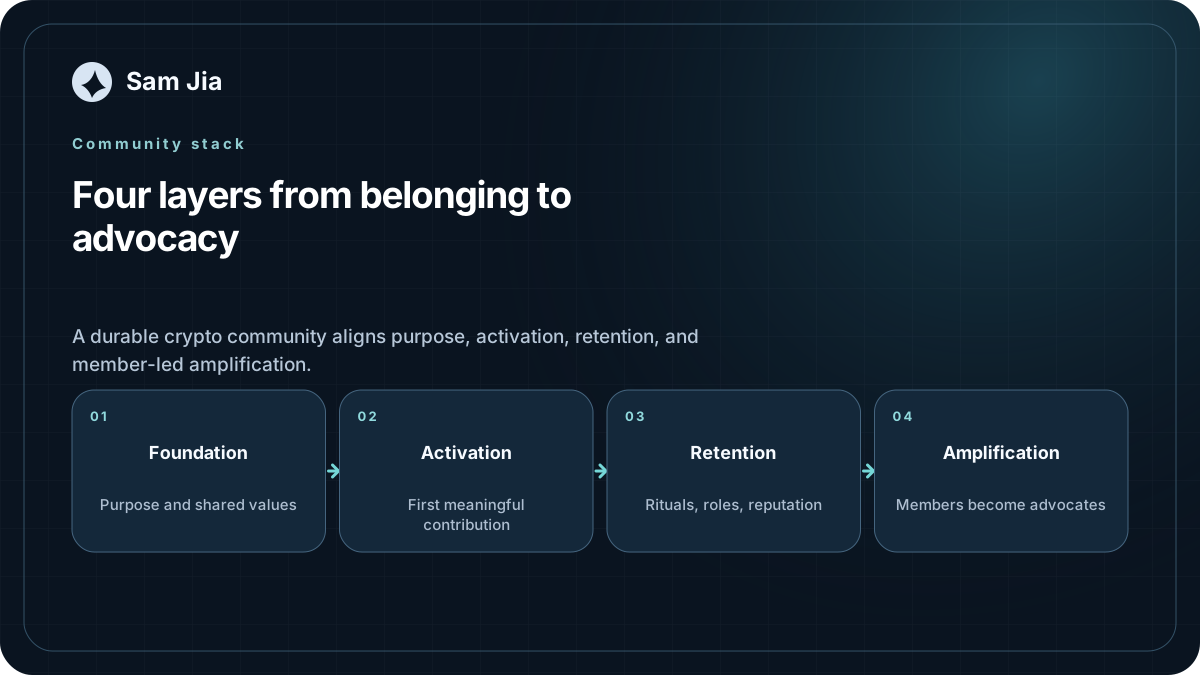
- The four-layer community stack (Foundation → Activation → Retention → Amplification) turns chaotic Discord servers into compounding growth engines
- Community operations — moderation workflows, content calendars, rhythm alignment — is the 80% of community building nobody talks about and everyone skips
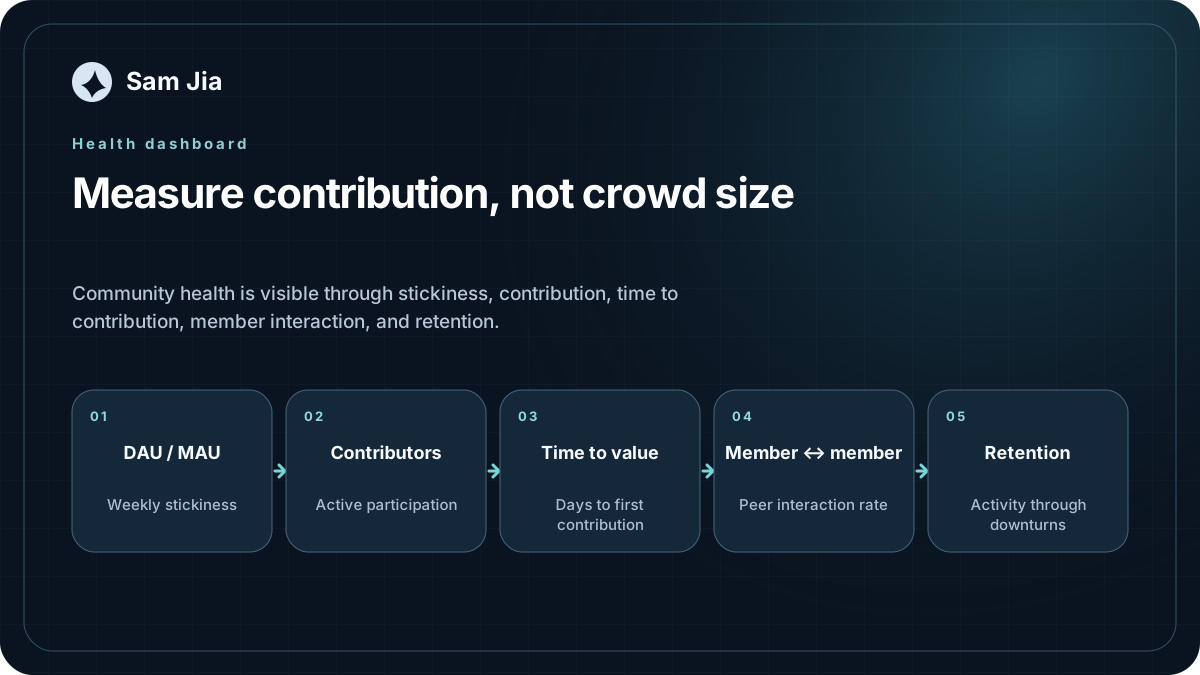
- The five metrics that actually predict community longevity: DAU/MAU stickiness ratio, contributor-to-lurker ratio, time-to-first-contribution, member-to-member interaction rate, and bear market retention
- Governance is not overhead — it’s community infrastructure. Without it, you’re building on sand
Why Most Crypto Communities Are Empty Theaters
Before I give you the framework, we need to diagnose the disease. Because if you don’t understand why your community is empty, you’ll just build the same thing again with different wallpaper.
The Airdrop Trap: Incentivized Participation vs. Genuine Engagement
Last year, a DeFi protocol I consulted for ran a points campaign that brought in 12,000 Discord members in two weeks. The team celebrated. Slack was full of rocket emojis. Six weeks after points ended, daily active members dropped to 180. That’s a 98.5% collapse.
They fell into the airdrop trap — a mistake so common in web3 community building that it’s practically standard operating procedure. If you’re figuring out how to build a crypto community from scratch, this is the first lesson: incentives without integration create extractors, not contributors. Here’s how it works:
You offer tokens or points for actions — joining Discord, retweeting, referring friends. People do those things. Numbers go up. You feel successful. But you’ve built a transactional relationship, not a communal one. The moment the transaction ends, so does the engagement.
This isn’t to say incentives are bad. It’s to say incentives without genuine onboarding are worse than no incentives at all. You attract the wrong people, set the wrong expectations, and poison the well for anyone who might have joined for real reasons.
If you want to see how this plays out in practice, explore the growth systems I build →
Community as Marketing Channel, Not Operating Layer
The second problem runs deeper. Most projects treat community as a marketing function — a place to announce things, run campaigns, and pump engagement numbers for investor decks. They hire community managers whose KPIs are message volume and member count.
A real community is an operating layer. It’s where:
- Product feedback arrives unfiltered, before it shows up in NPS surveys
- Power users train new users, reducing your support costs
- Bug reports come with reproduction steps because someone already debugged it
- Advocates defend the project when FUD hits Twitter, without being asked
When you treat community as marketing, you get marketing outcomes: attention that spikes and fades. When you treat it as an operating layer, you get operational outcomes: resilience, intelligence, and compounding growth.
The difference isn’t semantic. It determines everything — who you hire, what you measure, how you design onboarding, what software you choose. Most crypto projects never cross this mental chasm. They optimize for the wrong thing from day one and wonder why the building is empty.
The Metrics That Lie to You (and What to Measure Instead)
Here’s a short, incomplete list of metrics that crypto projects love and that tell you absolutely nothing:
- Total Discord members. A number anyone can inflate with a bot script and $200 in airdrop tokens.
- Messages per day. When 80% of those messages are “gm” and “wen token,” what exactly are you measuring?
- Twitter impressions. Bots. Bots everywhere.
- Telegram group size. Same problem as Discord, different platform.
I once took over a community that boasted 25,000 Telegram members to their investors. After cleaning bots and inactive accounts, there were roughly 2,300 real humans. The team knew this internally but kept showing the inflated number in pitch decks because “everyone else does it.”
The metric you should be measuring is stickiness: what percentage of your monthly active members show up daily? The crypto communities I’ve audited often sit in the low single digits; the stronger ones establish a repeatable habit rather than a one-time campaign spike. True web3 community engagement isn’t measured by who shows up once — it’s measured by who keeps coming back.
The Community Building Stack: 4 Layers
After years of building and fixing communities across DeFi, NFTs, and DAOs, I’ve developed a framework that breaks the problem into four layers. Each layer depends on the one below it. Skip a layer, and the whole thing collapses — usually around month three. This is the core of any effective web3 community building strategy: vertical dependency. You can’t activate members who don’t know why they’re here. You can’t retain people who’ve never made a contribution.
Here’s the crypto community building framework I use:
Layer 1: Foundation — Purpose, Values, and the “Why Join”
Most community leads skip this entirely. They jump straight into setting up Discord channels, designing role hierarchies, and planning “gm” bots. Nobody stops to answer the one question that matters: why would anyone spend time here instead of the 47 other crypto Discords they’re already in?
Your foundation has three components:
Purpose. What problem does this community solve for its members? Not for the project. For the members. If the answer is “they get to learn about our project,” congratulations — you’ve described a newsletter, not a community.
A DePIN project I worked with spent two weeks defining their community purpose before touching Discord. They landed on: “We’re building the place where hardware nerds and token economists actually talk to each other.” Specific. Differentiated. A reason to show up that doesn’t exist anywhere else.
Values. Three to five non-negotiable behavioral principles. Not generic ones like “be respectful” — specific ones that shape culture. One project’s values included “strong opinions, loosely held” and “no speculation in core channels.” The second one alone eliminated 40% of typical crypto Discord noise.
The promise. What does a member get after six months that they don’t get on day one? If you can’t articulate this, you’re building a lobby, not a community. A lobby is where people wait for something. A community is where people become something.
Layer 2: Activation — Onboarding, First Contribution, Reward Loop
Activation is the moment someone stops being a spectator and becomes a participant. In crypto communities, this moment is absurdly hard to engineer because most onboarding flows are designed for maximum speed, not maximum meaning.
Discord’s own Community Onboarding guide shows the platform-level version of this principle: ask new members what they care about, then use those answers to surface relevant roles and channels instead of dropping everyone into the same maze.
Here’s what a real activation sequence looks like:
Step 1: The 5-minute welcome. Not a bot that DMs “Welcome to the server! Read the rules!” That’s noise. I’m talking about a deliberate, human-touch onboarding that:
- Asks why they joined (and actually reads the answer)
- Connects them to one relevant channel based on their answer
- Introduces them to one real person, not a bot
Step 2: The first contribution. This is the most important moment in a member’s lifecycle. The first time they do something — answer a question, share a resource, give feedback — their brain makes a decision: “Am I part of this, or am I watching this?”
Design your channels so low-effort contributions are obvious and rewarded. This isn’t gamification fluff. It’s behavioral architecture. A simple “help-wanted” channel where members can answer quick questions from newbies is the difference between someone lurking forever and someone becoming a regular contributor within their first week.
Step 3: The reward loop. Not tokens. Recognition. A public thank-you from a core team member. A role badge. A mention in the weekly digest. Humans will do extraordinary things for recognition that costs you nothing.
Ready to build a community with real staying power? See how I help projects build operating systems from the ground up →
Layer 3: Retention — Rituals, Roles, Reputation Systems
Retention is where community building separates from community launching. Anyone can launch. Almost no one retains.
Rituals. Regular, predictable events that members build their schedules around. The weekly AMA. The Friday meme contest. The monthly contributor showcase. Rituals create rhythm, and rhythm creates habit. A community without rituals is a community without a heartbeat.
Here’s a concrete example. A gaming DAO I advised was struggling with engagement. We introduced three rituals:
- Monday Mission Briefing — a 30-minute voice chat where the team shared what they were building that week and asked for specific help
- Wednesday Work Session — a co-working call where contributors worked silently together, then shared progress
- Friday Showcase — members presented what they built that week; best contribution won a custom role
Eight weeks in, the Wednesday sessions had 40+ regular attendees. People were building projects because the ritual gave them a deadline and an audience. That’s what a real retention engine looks like.
Roles. Not just Discord roles — operational roles with real responsibility. When someone owns a channel, a weekly event, or an onboarding cohort, they stop being a member and start being an operator. Operators don’t churn. They can’t — they have skin in the game.
Reputation systems. Formal or informal ways of tracking who contributes what. This doesn’t need to be on-chain soulbound tokens (though it can be). A simple Google Sheet tracking contributions and awarding escalating privileges works fine. What matters is that contributions are visible and rewarded, creating a ladder for members to climb.
Layer 4: Amplification — Turning Members into Advocates
This is the layer most projects try to skip to, and it’s why their “ambassador programs” produce nothing but spam.
Advocacy is a result, not a strategy. When someone has been properly activated and retained — when they’ve made friends, earned reputation, and feel ownership — they’ll advocate naturally. Your job at the amplification layer is to remove friction from advocacy, not to manufacture it.
Variant’s essay on the ownership economy explains the deeper mechanism: ownership can turn users into contributors when participation gives them a meaningful stake in the network they help create.
Here’s what that looks like operationally:
- Content templates that make it easy for members to create UGC without starting from a blank page
- A “talk about us” channel where members can request assets, data, or quotes for their content
- Amplification loops where great member content gets signal-boosted by the official account, creating a virtuous cycle: create good content → get amplified → build your own following → create more good content
When a small NFT project I worked with implemented these three things, their organic Twitter mentions tripled in a month. Not because they launched an “ambassador program.” Because they made advocacy easy for people who already wanted to advocate.
Community Operations: The Unsexy Work That Matters
Here’s the part of community building that gets zero conference talks: operations.
Most community leads want to do strategy. They want to design tokenomics, plan campaigns, architect grand engagement schemes. But 80% of whether a community survives comes down to three operational pillars that nobody wants to talk about because they’re boring.
Moderation Workflows That Scale
When your community has 200 members, moderation is easy. You read everything. You handle problems personally. You know everyone by name.
At 2,000 members, this breaks catastrophically. You miss things. Spam slips through. Conflicts escalate because nobody caught them early. The culture starts degrading, and you don’t notice until your best members start leaving.
I learned this the hard way. In 2022, a community I managed grew from 400 to 3,800 members in six weeks during a token launch. Our moderation collapsed. We lost three of our top ten contributors before I realized what was happening. They didn’t announce their departure — they just went quiet, then gone.
Here’s the scalable moderation stack I built after that failure:
Discord’s AutoMod safety guide is a practical baseline for the automated layer, covering keyword rules, spam controls, and verification before issues reach a human moderator.
| Level | Who | What They Handle | Tool Support |
|---|---|---|---|
| Level 0 | Automation | Scam links, spam, known bad actors | Discord bots, custom filters |
| Level 1 | Junior Mods | First-pass triage, rule violations, basic questions | Ticket systems, macros |
| Level 2 | Senior Mods | Complex disputes, cultural enforcement, ban appeals | Escalation workflows |
| Level 3 | Community Lead | Policy decisions, crisis management, mod team health | Direct intervention |
The key insight: Level 0 should catch 60-70% of issues automatically. Level 1 should handle another 25%. If Level 3 (you) is handling more than 5% of moderation volume, your system is broken.
Content Calendar + Community Rhythm Alignment
Most crypto projects have two separate things: a marketing content calendar and a community events schedule. These should be one thing with two views.
When your content team drops a major announcement on the same day as your community AMA, both events cannibalize each other. When your meme contest coincides with a product launch, neither gets the attention it deserves.
Here’s what I use: a single calendar with three tracks:
- Product track — launches, updates, technical announcements
- Community track — AMAs, contests, contributor showcases, rituals
- Market track — reactions to industry news, thought leadership, ecosystem positioning
These three tracks operate on different rhythms (product is irregular, community is weekly, market is reactive), but they share one calendar and one owner. Before any community event is scheduled, we check: what’s happening in product and market that week? Before any announcement goes out, we ask: how does the community participate in this?
When to Automate, When to Be Human
The automation trap is seductive in crypto because we’re all technology natives. “Let’s build a bot for that” is the default answer to every operational problem.
Automate these:
- Scam detection and link filtering
- Welcome messages and basic channel navigation
- Event scheduling and reminders
- Role assignment based on verifiable actions (wallet connection, token holding)
Never automate these:
- Conflict resolution between members
- Onboarding conversations with high-potential new members
- Thanking contributors
- Crisis communications
- Cultural interventions
The rule is simple: automate logistics, humanize relationships. If a task involves emotional intelligence or cultural judgment, a bot shouldn’t touch it. If it involves repetitive data processing, a human shouldn’t touch it.
Measuring Community Health (Beyond Member Count)
I’ve already said member count is a vanity metric. So what should you measure instead?
The 5 Metrics That Actually Predict Community Longevity
After auditing dozens of crypto communities, these are the five signals that correlate with long-term survival:
1. DAU/MAU Stickiness Ratio. Daily active users divided by monthly active users. I use 20% as an operating target for a habit-forming community and treat sustained single-digit results as a warning that the space behaves more like a broadcast channel. These are operating thresholds from my audits, not universal industry benchmarks.
2. Contributor-to-Lurker Ratio. What percentage of your members have made at least one contribution (message, reaction, event attendance, bug report) in the last 30 days? In my reviews, 15-25% is a useful operating range; sustained results below 5% signal that you have an audience, not a participatory community.
3. Time-to-First-Contribution (TFC). How long does it take a new member to make their first contribution? The shorter this window, the more likely the member is to build a habit. I flag anyone who has not contributed within seven days for an onboarding review rather than assuming they will become active later.
4. Member-to-Member Interaction Rate. What percentage of messages are members talking to each other versus talking to team members or bots? If your community lead or core team is generating more than 40% of total messages, you don’t have a community — you have a Q&A channel with a host.
5. Bear Market Retention. This is the one metric that actually matters. What percentage of your active contributors are still active six months into a downturn? Communities that survive bear markets have one thing in common: members are there for each other, not for the token price.
I build custom dashboards for community operators who want to track what matters instead of vanity numbers. Let’s talk about your setup →
Dashboard Design for Community Operators
You don’t need a fancy analytics stack. Here’s the minimum viable dashboard:
| Metric | Target | Frequency | Alert If |
|---|---|---|---|
| DAU/MAU Stickiness | > 20% | Weekly | < 10% for 2 consecutive weeks |
| Contributor/Lurker Ratio | > 15% | Monthly | < 8% |
| Avg. TFC (days) | < 7 | Monthly | > 14 days |
| M2M Message % | > 60% | Weekly | < 40% for 2 consecutive weeks |
| Bear Market Retention | > 50% | Quarterly | < 30% during non-bear periods |
Track these five numbers. Review them weekly. In my operating model, if three of five are trending down, I treat it as a structural problem rather than a content problem. Don’t fix it with more AMAs.
Notion’s collection of operations templates shows the practical building blocks for a lightweight operating dashboard: clear ownership, recurring review, linked work, and progress that can be inspected without a separate reporting ceremony.
When Community Becomes a Liability: Governance and Moderation at Scale
There’s a paradox in community building that nobody warns you about: growth makes your community worse before it makes it better.
The Paradox of Growth: More Members, More Noise
Every new member adds potential value but also adds potential noise. The signal-to-noise ratio of a community degrades as it grows unless you actively manage it. This is why so many great small communities get ruined by “success” — they scale their member count without scaling their culture defense mechanisms.
I saw this destroy a DAO community in 2023. They grew from 300 to 6,000 members in a quarter. The original members — the ones who built the culture — got drowned out by newcomers who didn’t understand the norms. Conflicts erupted. The OGs left. Within six months, the community was a hollow shell of its former self, still “growing” in raw numbers but spiritually dead.
The fix is cultural infrastructure that scales:
- Written cultural norms, not just rules. Rules say what you can’t do. Norms say what you should do.
- Norm-setting by example. Your most visible members — especially team members — must model the behavior you want. Every team member who says “gm” and nothing else is actively teaching the community that “gm” is what we do here.
- Graduated access. New members earn their way into deeper channels. This isn’t gatekeeping — it’s protecting signal. The people who earn access value it more, contribute more, and set better examples.
Governance as Community Infrastructure
Governance isn’t just about token voting on protocol upgrades. It’s about how decisions get made in your community, who has a voice, and how disputes get resolved.
Variant’s catalog of progressive decentralization is useful here because it sequences product-market fit, community participation, and distributed ownership instead of treating governance as a one-size-fits-all vote attached to every community decision.
Most communities operate as dictatorships with a friendly face. One person (the community lead) makes all the calls. This works until it doesn’t — usually when the lead burns out or a decision angers a vocal minority.
Here’s what governance-as-infrastructure looks like:
- Decision domains. Clearly define which decisions are made by the team, which are consulted with the community, and which are community-led. No ambiguity.
- Escalation paths. When a member has a problem with a moderator’s decision, where do they go? If the answer is “DM the community lead,” you’ve built a bottleneck, not a system.
- Contribution tracking. Record who does what. When it’s time to distribute rewards, access, or recognition, decisions should be based on verifiable contribution history, not vibes.
- Succession planning. What happens when you leave? If the answer is “the community dies,” you haven’t built a community — you’ve built an audience for yourself.
None of this requires on-chain governance. A Google Doc and consistent application work fine for most communities under 5,000 active members. What matters is that the system exists, is documented, and is applied consistently.
Conclusion: The Community That Survives the Bear Market
Here’s the thing about crypto community building: anyone can fill a Discord server during a bull run. Crypto community growth during euphoria is gravity-assisted — it tells you nothing about whether you’ve built something real. Airdrops, hype, FOMO — the gravity of a rising market does all the work for you. The test isn’t how many people show up when your token is pumping. The test is who’s still there when it’s down 85% and Twitter is calling your project dead.
A great community isn’t the one with the most members. It’s the one that survives the bear market — and comes out stronger.
The framework I’ve laid out here — Foundation, Activation, Retention, Amplification, Operations, Measurement, Governance — isn’t a growth hack. It’s a discipline. It’s the difference between building a theater that fills up for one show and building a city where people actually live.
If you take one thing from this article, let it be this: stop optimizing for the number of people who joined. Start optimizing for the number of people who stay.
Build the Foundation first. Design your Activation to make first contributions inevitable. Run Retention rituals that give your community a heartbeat. Let Amplification happen naturally as a result. Do the boring operational work. Measure what matters. Build governance before you need it.
Do those things consistently for 18 months, and you’ll have something that most crypto projects will never have: a community that compounds.
Ready to build a community that can survive a bear market? Let’s talk →
Related reading
Continue the operating conversation
Get occasional notes on crypto operations, AI workflows, and growth systems. No spam. Unsubscribe anytime. Usually fewer than two emails per month.