High-signal AI workflows for crypto operators
The easiest way to make an AI workflow look impressive is to add more agents, more integrations, and more generated output.
The harder—and more useful—goal is to make a team measurably clearer and faster.
That distinction matters in crypto. Markets move continuously, information is fragmented, and teams often operate across product, community, content, partnerships, and research at the same time. A workflow that merely produces more material can amplify the exact problem it was supposed to solve.
I use four tests when deciding whether an AI workflow is worth keeping.
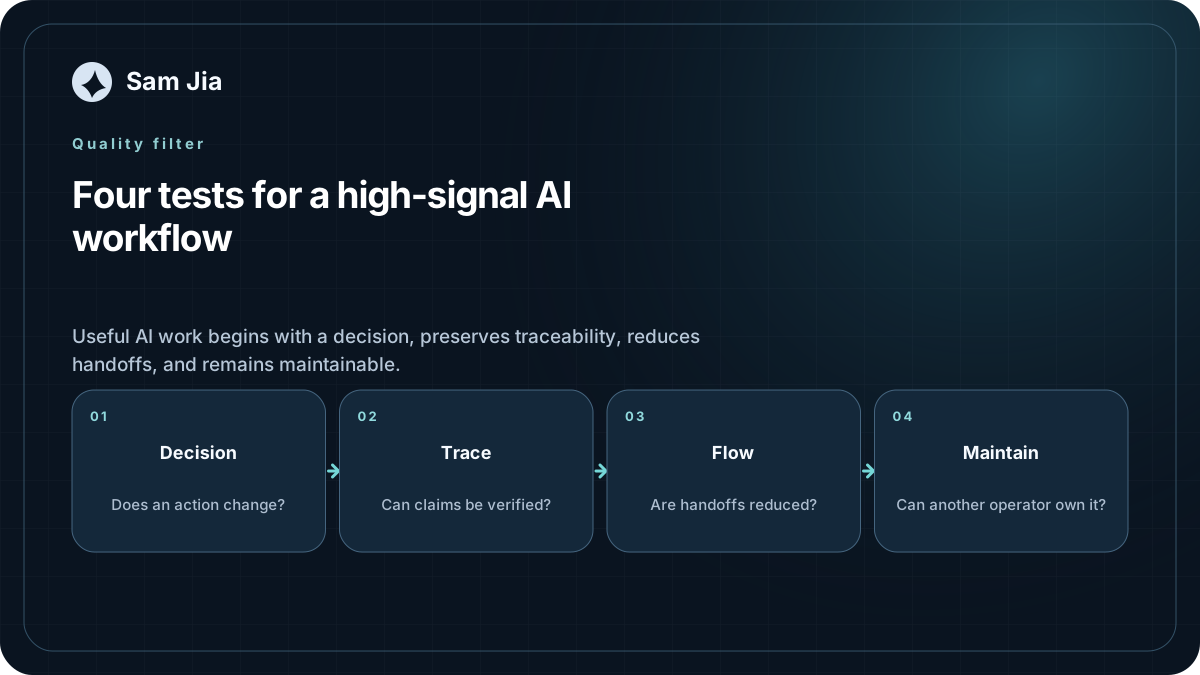
1. Does it begin with a real decision?
A useful workflow starts with a question someone is responsible for answering:
- What changed since the last review?
- Which signal deserves action?
- What is blocked, and who owns the next step?
- What should we stop doing?
If the output cannot change a decision, it is probably a content generator rather than an operating system.
That standard starts before the prompt. Anthropic’s prompt engineering overview recommends defining success criteria and an empirical way to test them before optimizing instructions.
2. Can every important claim be traced?
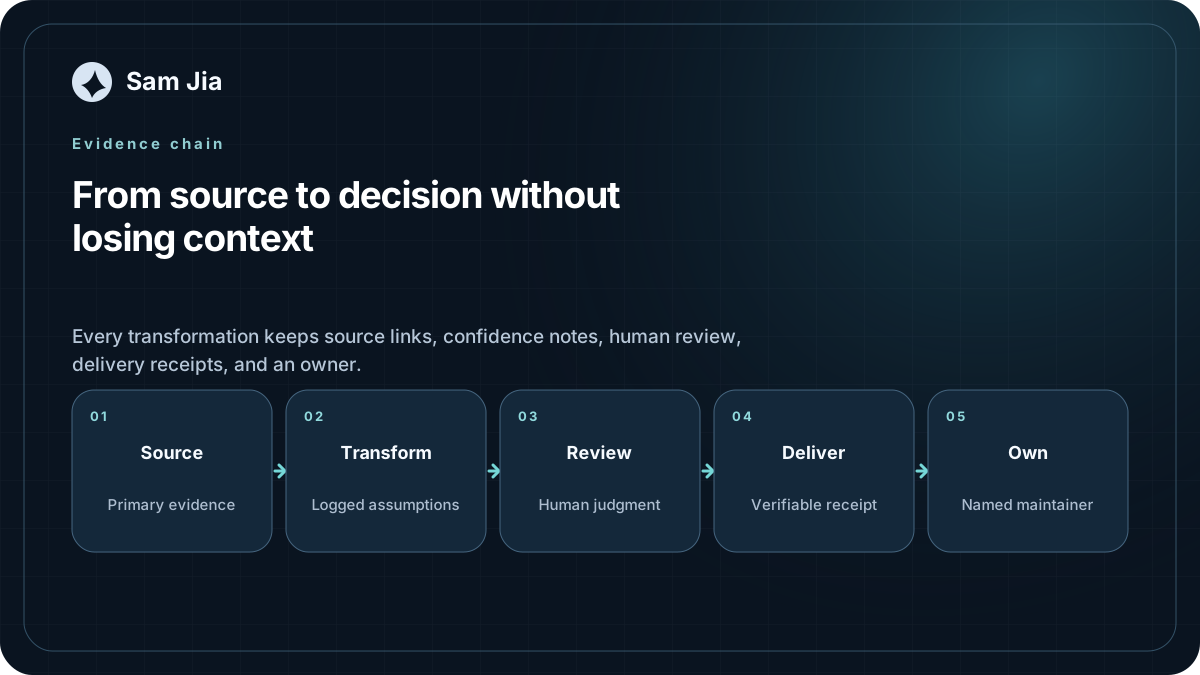
Speed is not a substitute for evidence. For research, reporting, and monitoring workflows, the final output should preserve the path back to source material.
That means distinguishing observed facts from inference, recording timestamps, and stating when data is missing or conflicting. A short, honest gap is more useful than a confident sentence assembled from weak signals.
For automated systems, traceability also needs technical evidence. The OpenTelemetry observability primer shows how traces, metrics, and logs preserve context across a request path instead of reducing it to a single success message.
3. Does the workflow reduce handoffs?
Automation creates leverage when it removes coordination cost. A strong workflow should reduce at least one of these:
- Reformatting the same information for multiple audiences
- Rechecking whether a task was actually completed
- Reconstructing context from scattered tools
- Manually comparing today with the previous baseline
- Turning raw findings into an action-ready brief
The goal is not to remove people. It is to let people spend more time on judgment.
GitLab’s asynchronous communication guide applies the same principle to distributed work: complete context, explicit next steps, and searchable documentation reduce avoidable coordination loops.
4. Can another operator maintain it?
Fragile automation usually depends on hidden context: an undocumented prompt, a local file only one person understands, or a chain of tools with no visible failure state.
A durable workflow has a clear input contract, a small number of moving parts, explicit failure language, and a handoff note. If it breaks, the next operator should know where to look and what “healthy” means.
The practical standard
I think of AI-native operations as a quality discipline rather than a technology category.
The best systems are often quieter than the demos. They collect less, summarize with more restraint, surface uncertainty, and end with a small number of decisions. They make the team feel calmer because the signal is easier to trust.
When choosing an automation layer, look for the human checkpoints, rule-based validation, and audit trails described in n8n’s AI workflow guidance, not just the number of integrations in a demo.
That is the standard I want: less operational drag, fewer invented certainties, and more time for the work that still requires human judgment.
Related reading
Continue the operating conversation
Get occasional notes on crypto operations, AI workflows, and growth systems. No spam. Unsubscribe anytime. Usually fewer than two emails per month.